
ADVERTISER DISCLOSURE: The Frugal Tourist is part of an affiliate sales network and receives compensation for sending traffic to partner sites, such as MileValue.com. This compensation may impact how and where links appear on this site. This site does not include all financial companies or all available financial offers. Terms apply to American Express benefits and offers. Enrollment may be required for select American Express benefits and offers. Visit americanexpress.com to learn more. All information about the American Express Schwab Platinum has been collected independently by The Frugal Tourist.
EDITORIAL DISCLOSURE: Opinions, reviews, analyses & recommendations are the author’s alone and have not been reviewed, endorsed, or approved by any of these entities.
Welcome back! If you are joining me from Part 1, you’ve already conquered Wall Street and the “Old New York.”
If you are just jumping in here, welcome to the second leg of my heart-healthy walking tour of Lower Manhattan.
As I recover from heart bypass surgery, I have found that walking is the ultimate way to reconnect with my body and the world around me.
This section of the tour is particularly special to me.
It focuses on resilience—both the city’s bounce back after tragedy and the structural marvel of the Brooklyn Bridge.
We are going to cover some serious ground here, so tighten those laces.
We are walking from the solemn beauty of the World Trade Center to the breathtaking views of DUMBO, Brooklyn.
Why This Walk is Highly Recommended
If Part 1 was about history, Part 2 is about emotion and engineering.
This route connects two of the most recognizable landmarks on the planet, offering a journey that moves from solemn reflection to soaring inspiration.
| NYC Walking Tour #2 Stats |
|---|
| Total Distance: |
| Approx. 2 miles |
| Estimated Time: |
| 2 – 3 hours (Allow time for reflection at the Memorial) |
| Step Count Goal: |
| ~4,500 steps (plus some incline!) |
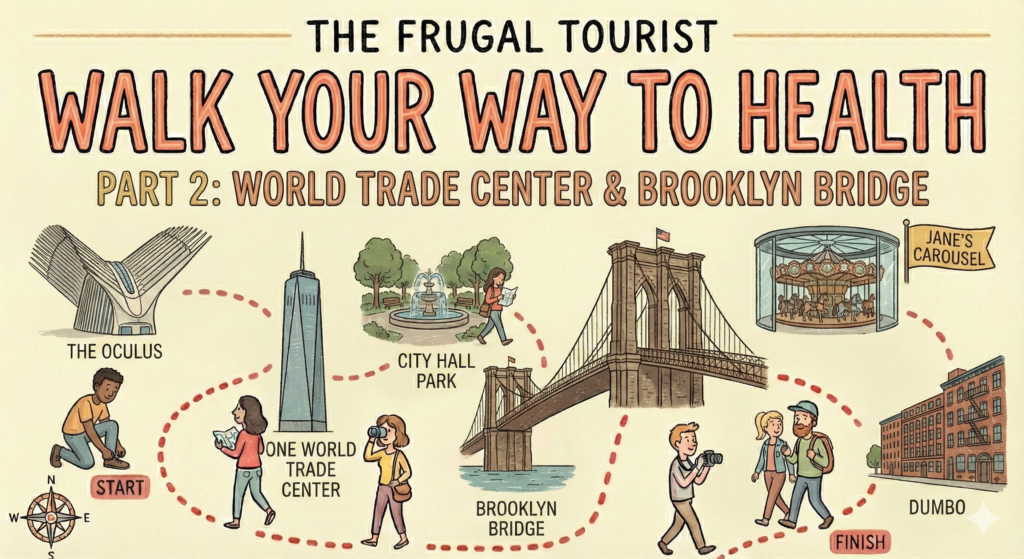
NYC Walking Guide Part 2 Map
Feel free to download or share this map.
Highlights of NYC Walking Guide Part 2
- A Story of Resilience: Witness the rebirth of Lower Manhattan at the World Trade Center, a site that has transformed from a place of tragedy into a beacon of hope.
- Architectural Marvels: Stand inside the ribs of The Oculus and gaze up at the towering One World Trade Center.
- The World’s Most Famous Bridge: Walking the Brooklyn Bridge is a bucket-list item for a reason. The experience of crossing the East River on foot, surrounded by the web of steel cables, is unforgettable.
- Unbeatable Views: The walk concludes in DUMBO, offering the classic cinematic view of the Manhattan skyline that you’ve seen in countless movies.
Where I Stayed on Points: Luxury for $0
Before we hit the pavement, I want to share how I managed to stay in this expensive part of the city without breaking the bank.
As a “Frugal Tourist,” I rarely pay cash for hotels.
Instead, I leverage points earned from my credit cards, such as the Chase Sapphire Preferred® Credit Card, to book luxury stays for free.
For this Lower Manhattan adventure, I utilized the World of Hyatt portfolio at two different properties:
- The Beekman, a Thompson Hotel: An absolute gem with old-world charm. It’s perfect if you want to feel like a tycoon from the Gilded Age without spending a dime.
- Gild Hall, a Thompson Hotel: A fantastic value option that is stylish, comfortable, and ideally located for this walking tour.
By using points, I saved hundreds of dollars a night—money that I could then invest in healthy meals, future travels and early retirement.
It’s the smartest way to recover in style!

Join Our Free Travel Miles & Points Facebook Group
Best Time to Visit NYC for Walkers
Since this itinerary relies heavily on being outdoors, timing your visit is crucial.
- The Sweet Spot (Spring & Fall): The months of April–May and September–October are ideal. The temperatures are crisp (perfect for keeping your heart rate steady), the humidity is low, and the foliage in the parks provides a beautiful backdrop.
- Summer Caution: NYC in July and August can be stifling. The concrete radiates heat, and the humidity can be taxing on the body. If you visit then, walk early in the morning (before 9 AM) to beat the heat.
- Winter Warning: While hotel rates are lower in January and February, the wind chill on the Brooklyn Bridge can be brutal. If you walk in winter, thermal layers are non-negotiable.
Restrooms
Note: There are NO restrooms on the Brooklyn Bridge itself.
The Oculus: Clean public restrooms are available on the lower levels near the shops. Go here before you start!
Brookfield Place: (Optional Detour) If the Oculus lines are long, walk across the street to the Brookfield Place winter garden.
Brooklyn Bridge Park: There are public restrooms at the end of the tour near Jane’s Carousel.
Water and Accessibility
The City Hall Park has fountains where you could refill your water bottle and rehydrate.
This entire route is also wheelchair and stroller accessible!
The Oculus has elevators, the sidewalks are paved, and the Brooklyn Bridge has a ramp entrance (though it is a steady incline).
How to Get to the Starting Point
Start Location: The Oculus (World Trade Center).
From Part 1: If you are continuing from our first tour, simply walk north on Broadway for about 10 minutes until you see the white, winged building.
By Subway: Take the E train to World Trade Center, the R/W to Cortlandt Street, or the 1 train to WTC Cortlandt.
The “Resurrection” Route: 10 Modern Landmarks
1. The Oculus
If you are joining us from Part 1, welcome back!
From Wall Street, head north on Broadway or Church Street toward the towering One World Trade Center.
You will see a massive white structure with “wings” designed by architect Santiago Calatrava.
This is The Oculus.
Think of it as a futuristic train station and shopping mall wrapped in art.
The design is meant to look like a white dove being released from a child’s hands.
Inside, it is bright, open, and peaceful.
It gives off a totally different vibe from the busy skyscrapers outside.
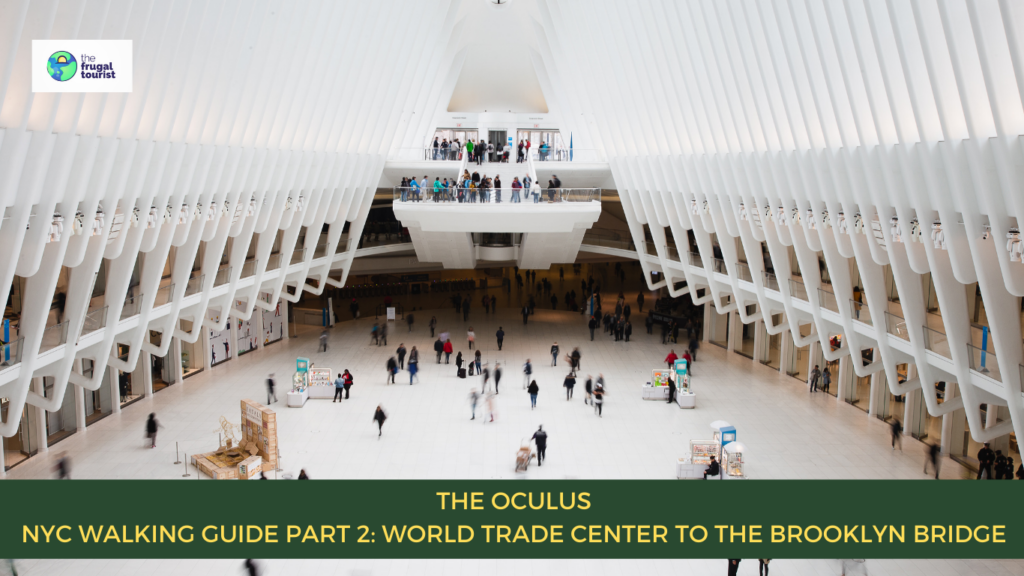
- Insider Tip: Walk to the very center of the floor and look up at the long skylight (the “spine”) on the roof. It was built with a special purpose: every year on September 11th at 10:28 AM, the sun shines perfectly through that window, marking the exact minute the second tower fell.
2. The Sphere (Koenig Sphere)
Walk from the Oculus toward Liberty Park, the elevated park overlooking the memorial.
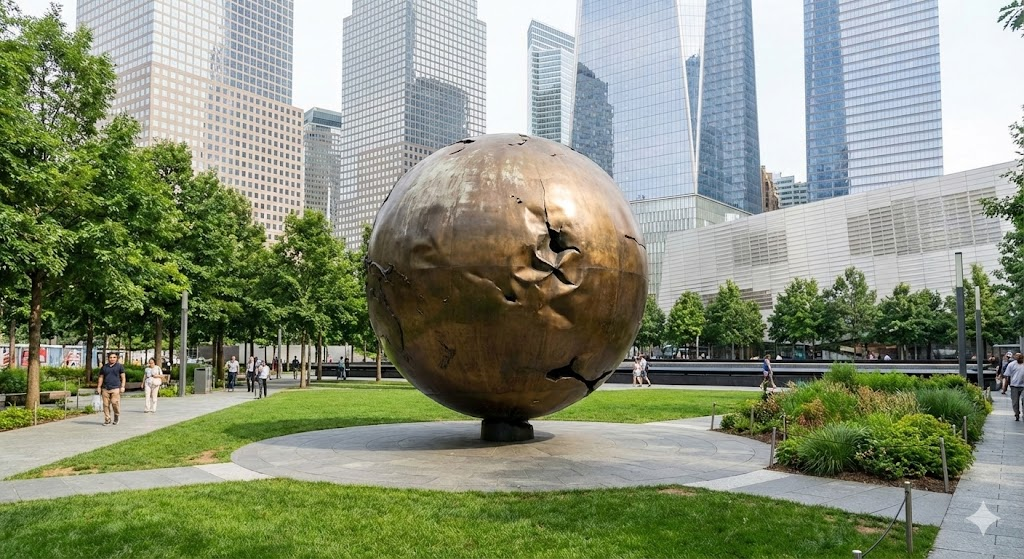
Before you visit the pools, take a moment to visit The Sphere.
This 25-foot bronze sculpture originally stood right in the center of the plaza between the Twin Towers.
It was one of the only works of art to survive the collapse on 9/11.
Although it is dented and scarred from the debris, it stands tall today in Liberty Park.
It is a powerful symbol of New York’s resilience.
Battered but unbroken.
Worth the Detour: St. Nicholas Greek Orthodox Church and National Shrine
Rebuilt and opened in 2022, St. Nicholas is also at Liberty Park, next to the Sphere.
It is the only house of worship destroyed on 9/11 and was rebuilt by architect Santiago Calatrava (same as the Oculus).
If your schedule allows, come back in the evening as it glows at night.
Insider Tip: Since Liberty Park is elevated (it is on top of a vehicle security center), it offers the best “bird’s-eye view” of the entire 9/11 Memorial Plaza. It is a quiet spot to take in the scale of the site away from the crowds.
3. The 9/11 Memorial Museum & Memorial Pools
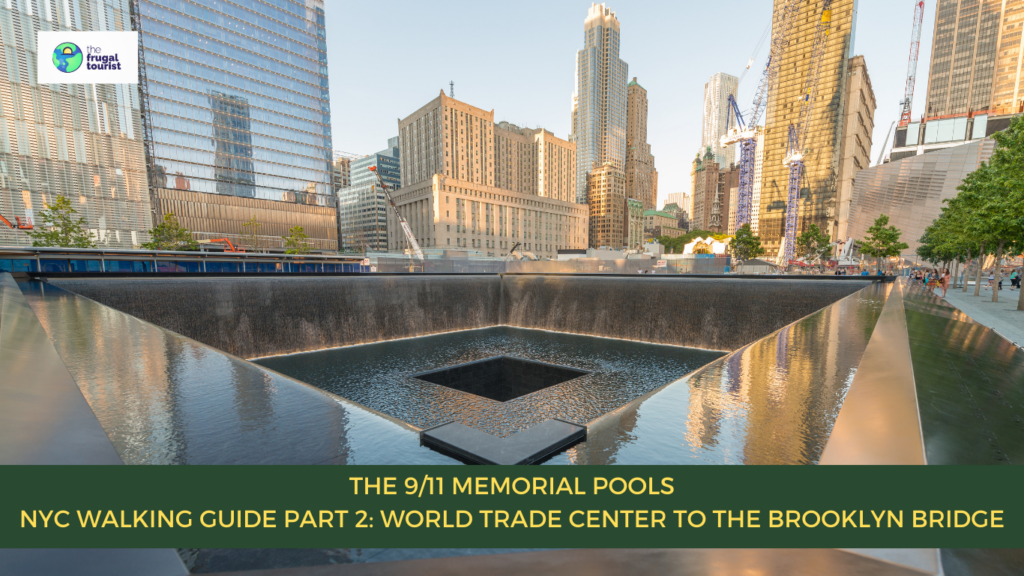
Outside the Oculus are the two massive reflecting pools set within the footprints of the original Twin Towers.
They are the largest man-made waterfalls in North America.
The bronze parapets surrounding the pools list the names of every person who died in the 2001 and 1993 attacks.
It is a place of profound silence despite the city’s noise.
Situated between the iconic reflecting pools, the 9/11 Memorial & Museum is a profoundly moving tribute to resilience that takes you deep into the bedrock of the original Twin Towers.
It is a must-see experience that lets you view powerful artifacts like the ‘Survivor Stairs’ and reflect on the city’s history in the exact spot where it happened.
- Insider Tip: Look for white roses placed in the names on the parapets. These roses indicate that the victim’s birthday is today. It is a touching tribute maintained by the museum staff.
Worth the Detour: The Survivor Tree
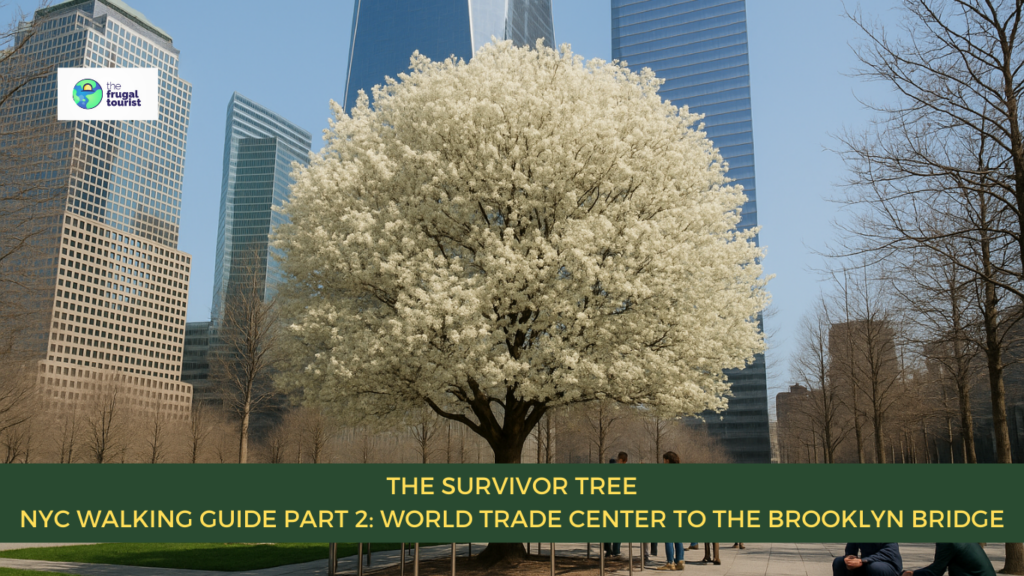
Located on the plaza near the pools is a Callery pear tree.
This tree was discovered in the rubble of Ground Zero, severely burned and with snapped roots.
It was nursed back to health and replanted here.
It stands as a living symbol of resilience and rebirth, a theme that resonates deeply with me during my own recovery.
Notice how the new limbs are smooth, while the older bark is gnarled and scarred.
It’s a beautiful metaphor for healing: we carry our scars, but we continue to grow.
4. One World Trade Center (Freedom Tower)
Towering 1,776 feet above you (a nod to the year of independence), this is the tallest building in the Western Hemisphere.
Its shimmering glass surface reflects the sky and the changing weather.
While the observation deck costs money, admiring the sheer scale of the building from the ground is awe-inspiring and free.

- Insider Tip: The best angle for a photo that captures the whole tower is actually from the corner of West Broadway and Vesey Street, just a block away.
5. St. Paul’s Chapel
Walk east on Vesey Street to Broadway.
Built in 1766, this is Manhattan’s oldest surviving church building.
This church survived the great fire of 1776.
Miraculously, despite being right across the street from the Twin Towers, it also suffered no damage on 9/11.
It became a sanctuary for recovery workers, providing food, rest, and therapy.
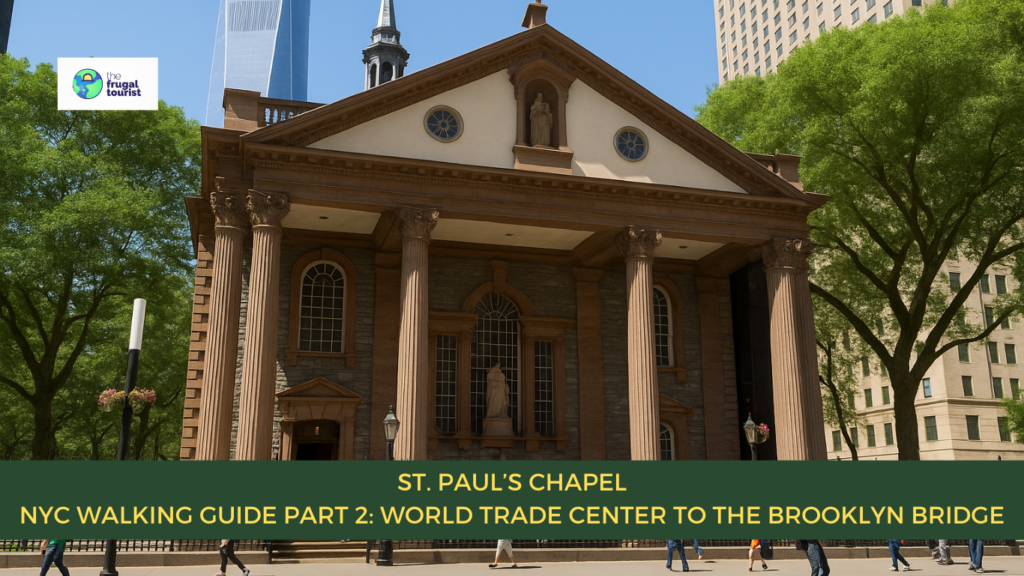
- Insider Tip: Go inside (it’s free). You can still see the pew where George Washington prayed on his inauguration day. The history here spans from the Revolution to the modern day.
6. The Woolworth Building
Continue north on Broadway/Park Row.
Once the tallest building in the world (1913-1930), this skyscraper is nicknamed the “Cathedral of Commerce.”
Its Gothic detailing, gargoyles, and copper roof make it one of the most beautiful buildings in NYC.
It was paid for in cash (without a mortgage) from Frank Woolworth’s empire.
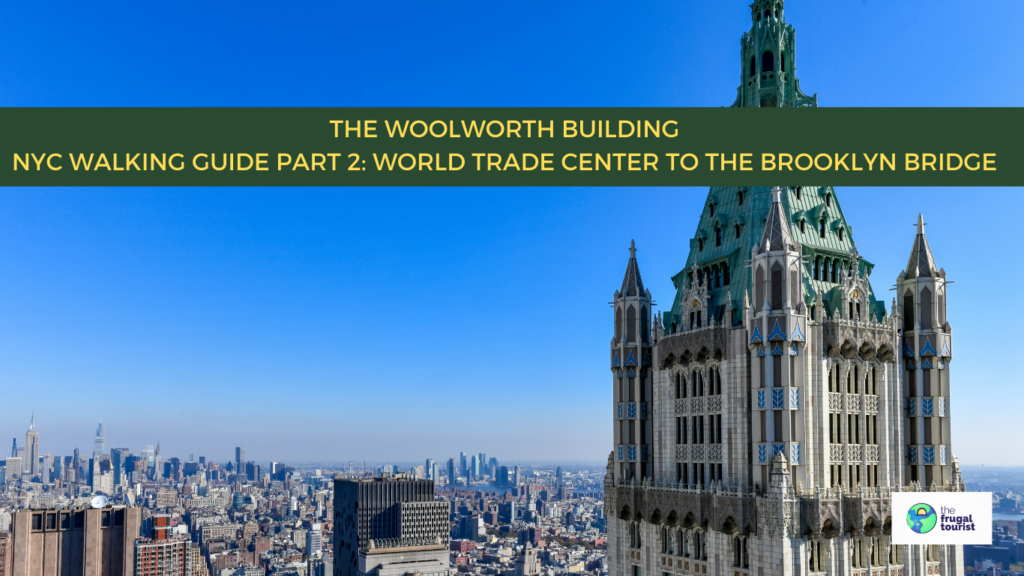
- Insider Tip: Tourists generally can’t go past the lobby security, but peek through the glass doors to see the stunning mosaic ceiling. It’s a masterpiece of early 20th-century design.
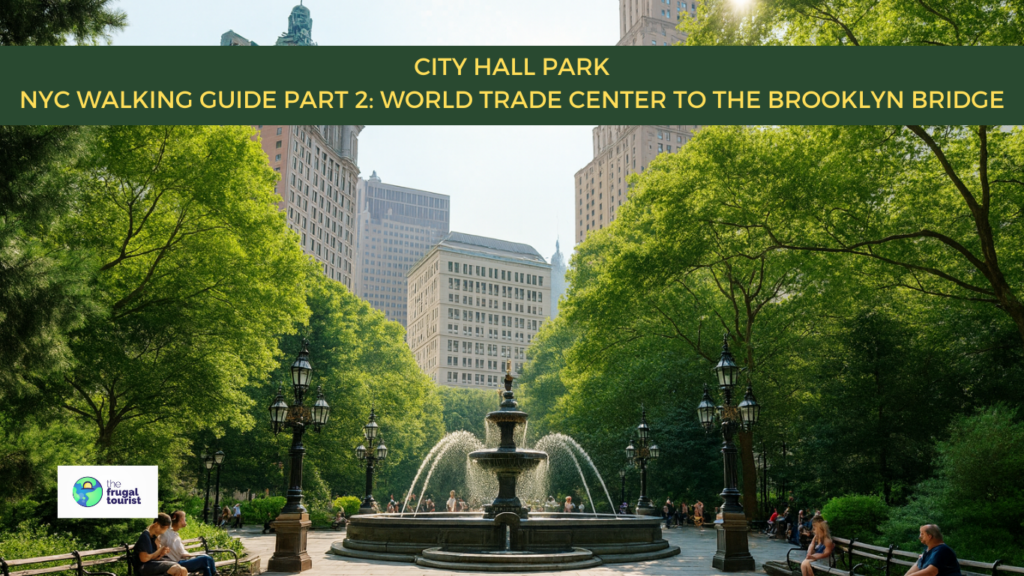
7. New York City Hall Park
Across from the Woolworth Building is our next stop: New York City Hall Park.
This park serves as the city’s civic center.
You will see the beautiful French Renaissance-style City Hall, one of the nation’s oldest functioning city halls.
The park itself is a lovely, tree-lined respite and marks the gateway to the Brooklyn Bridge.
| For History Buffs |
|---|
| The Declaration of Independence Plaque: Near the Broadway entrance of the park, there is a plaque marking the spot where George Washington had the Declaration of Independence read to his troops for the first time in NYC (July 9, 1776). |
| Hidden Gem |
|---|
| The Ghost Station: While standing in City Hall Park, you are standing directly on top of the famous abandoned ‘City Hall’ subway station. It’s no longer accessible to the public, but its beautiful curved arches and skylights still exist silently beneath your feet. |
- Insider Tip: There is a fountain here that dates back to the completion of the Croton Aqueduct in 1842, which brought the first clean water to NYC. Don’t forget to bring a reusable water bottle as this is a great spot to rehydrate.
8. The Secret Entrance to the Brooklyn Bridge
Our next stop is located across from the east side of City Hall Park.
Finding the entrance can be tricky because it is not right at the waterfront.
Safety Note: The entrance is now strictly for pedestrians (bikes have their own lane on the road below), so you don’t have to worry about speeding cyclists.
Where to go: From City Hall Park, cross Centre Street toward the big municipal building with the arch.
Look for: You will see a promenade (walkway) that rises up in the middle of the street. Don’t try to cross the highway! Look for the wide path marked “Brooklyn Bridge Pedestrian Walkway.”
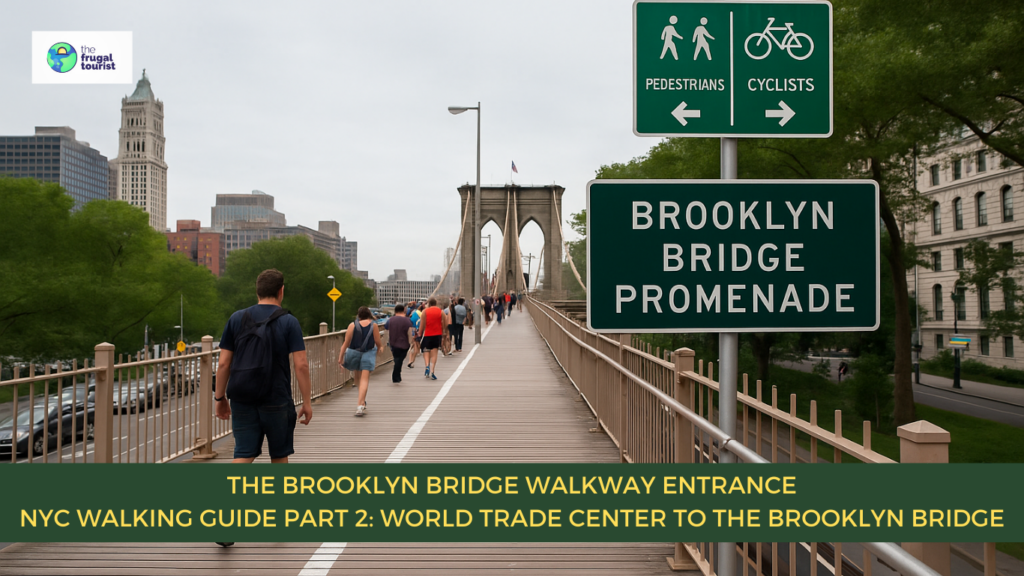
- Insider Tip: Enjoy the freedom! The city has moved all bicycle traffic to the roadway below. The wooden promenade is now exclusively for pedestrians, so you can safely use the full width of the path without dodging cyclists.
| Love Locks Warning |
|---|
| You will see thousands of padlocks clipped to the bridge by couples. Please do not add one. The weight damages the bridge, and the city sends crews to cut them off regularly. Save your money and take a photo instead! |
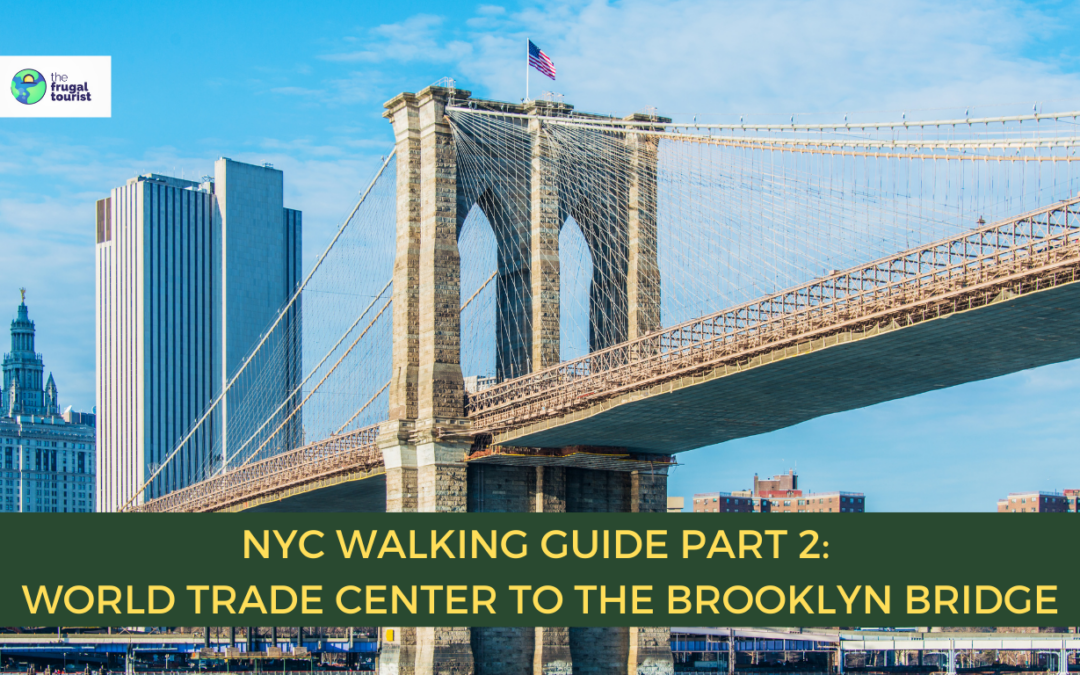
9. The Brooklyn Bridge Gothic Towers & Cables
Walking across the bridge is a bucket-list experience.
As you reach the first granite tower, stop to admire the Gothic arches.
Completed in 1883, this was an engineering miracle.
The web of steel cables framing the Manhattan skyline is one of the most photogenic spots on earth.
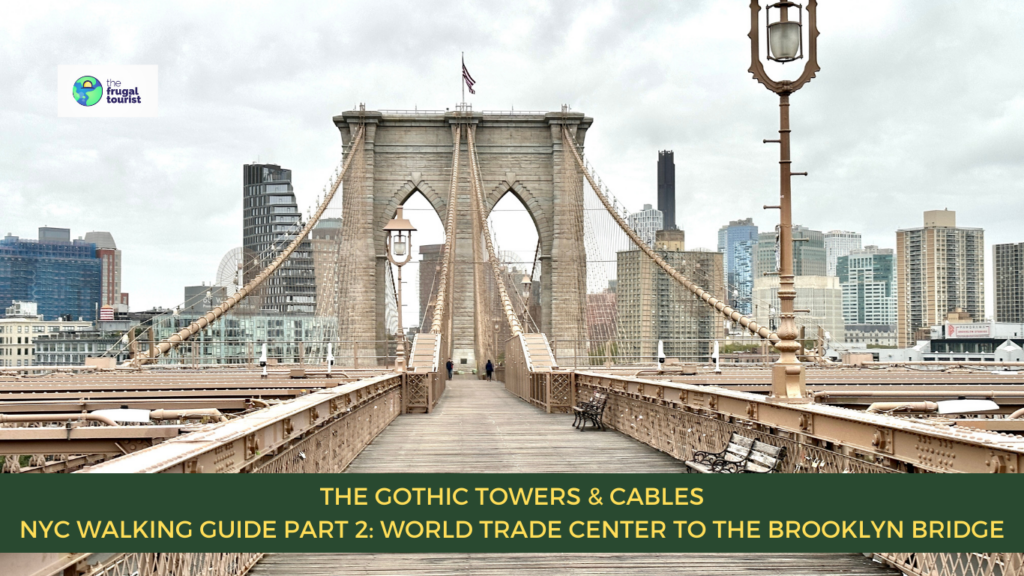
- Insider Tip: Halfway between the two towers, there are plaques dedicated to the Roebling family (the designers). It’s a good spot to catch your breath and learn about the sacrifice involved in building this span.
| For History Buffs |
|---|
| The Cold War Bomb Shelter: While you cannot enter it, it is fascinating to know that inside the masonry of the bridge (specifically the Manhattan anchorage), there is a forgotten fallout shelter discovered in 2006, still stocked with survival crackers and water drums. |
10. DUMBO & Brooklyn Bridge Park
Exit the bridge in Brooklyn and take the stairs down to Washington Street.
You made it to Brooklyn! Now it is time for a reward.
The Best View: Walk to “Pebble Beach” in the park. It is a rocky beach right on the water. Sit on the stone steps and watch the sunset over the city. It is the best free theater in New York.
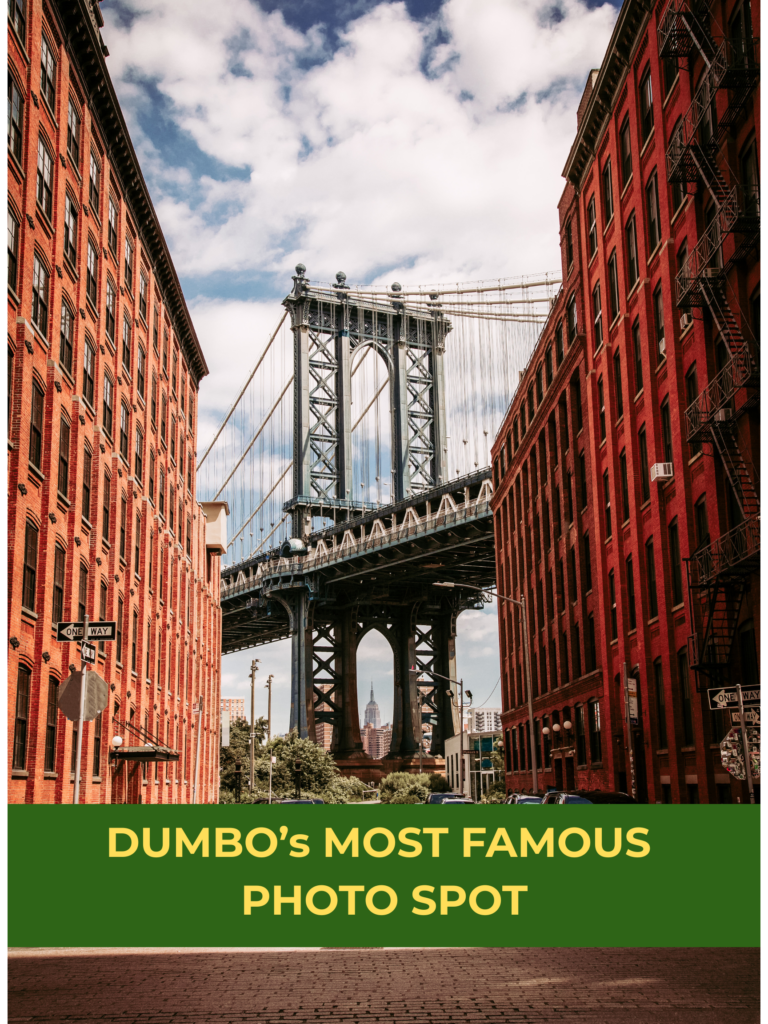
The Famous Photo: Go to the intersection of Washington Street and Water Street. You will see the Manhattan Bridge perfectly framed by red brick buildings. If the weather is clear, you can even see the Empire State Building peeking through the bridge’s legs!
Another Photo Op: Jane’s Carousel: This restored 1922 carousel deserves its own spotlight. It is beautiful, year-round, and cheap.
Budget Treat: You just burned a lot of calories. Grab a slice of pizza at Front Street Pizza (usually less of a line than the famous Grimaldi’s).
More Dining Options: Time Out Market (55 Water St). It is a massive food hall in DUMBO with 20+ vendors (including high-end pizza and ice cream).
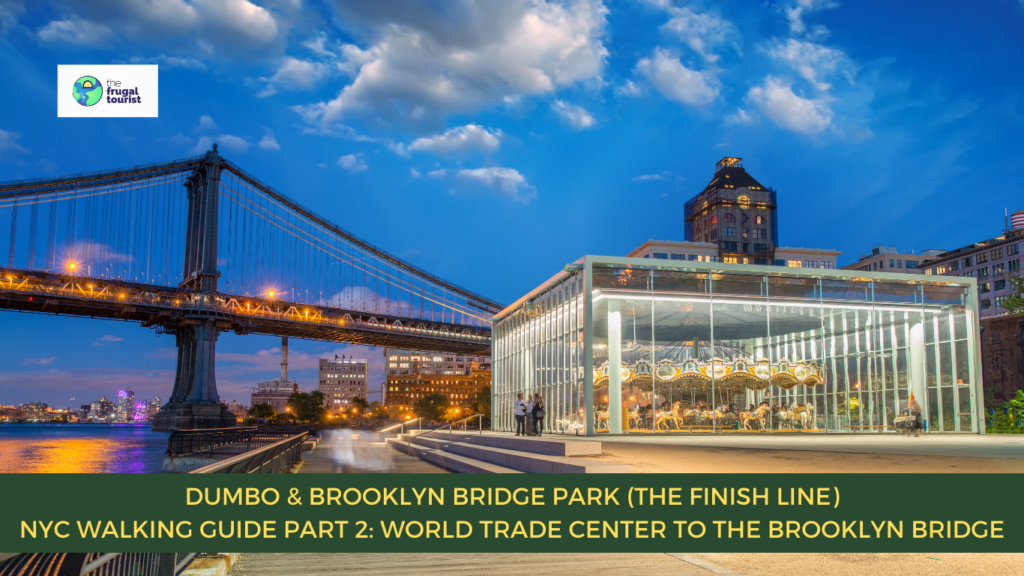
- Insider Tip: Collapse on the lawn at Brooklyn Bridge Park. You have earned it. The view of the Manhattan skyline from here is the best reward.
After the Finish Line
Once you finish the hike, you have three options:
Explore: Continue your adventure by walking further into Brooklyn.
Walk: Head back to Lower Manhattan by walking across the Brooklyn Bridge.
Ride: Take a ferry or the subway back to your accommodation.
The Ferry: It’s the most scenic way to return to Manhattan (Wall St. or Midtown).
The Subway: Hop on the F Train at York Street (deepest station, good for cool air) or the A/C Train at High Street.
Must-Have Walking Essentials
Since this leg involves crossing the river, the elements are a bigger factor.
- Layer Up: The wind on the Brooklyn Bridge can be fierce, even in summer. A light windbreaker or scarf is essential.
- Portable Charger: You will be taking hundreds of photos. A dead phone is the last thing you’d want.
- Sun Protection: There is zero shade on the bridge. A hat and sunscreen are mandatory.
- Reusable Water Bottle: The fountains at City Hall Park is a good refill station to save a few dollars.
- Pace Yourself: The incline on the bridge is real. If you are recovering like me, don’t be afraid to stop at the benches along the way.
Final Thoughts
Navigating from the historic Battery (in Part 1) to the soaring heights of the Brooklyn Bridge gives you a sense of accomplishment that a tour bus simply cannot provide.
You have walked approximately 3.5 to 4 miles total, burned decent calories, and seen the evolution of one of the world’s greatest cities up close.
For the frugal traveler, this day costs $0 in attraction fees, leaving you with a budget to spare for a nice, healthy meal in Manhattan or in Brooklyn.
Safe travels and keep walking!
Disclaimer: I am a travel enthusiast, not a doctor. Always consult your cardiologist or healthcare provider before engaging in rigorous physical activity, especially after surgery.
ADVERTISER DISCLOSURE: The Frugal Tourist is part of an affiliate sales network and receives compensation for sending traffic to partner sites, such as MileValue.com. This compensation may impact how and where links appear on this site. This site does not include all financial companies or all available financial offers. Terms apply to American Express benefits and offers. Enrollment may be required for select American Express benefits and offers. Visit americanexpress.com to learn more. All information about the American Express Schwab Platinum has been collected independently by The Frugal Tourist.
EDITORIAL DISCLOSURE: Opinions, reviews, analyses & recommendations are the author’s alone and have not been reviewed, endorsed, or approved by any of these entities.
USER-GENERATED CONTENT DISCLOSURE: The comments section below is not provided or commissioned by the bank advertiser. Responses have not been reviewed, approved, or otherwise endorsed by the bank advertiser. It is not the bank advertiser’s responsibility to ensure all questions are answered.