

ADVERTISER DISCLOSURE: The Frugal Tourist is part of an affiliate sales network and receives compensation for sending traffic to partner sites, such as MileValue.com. This compensation may impact how and where links appear on this site. This site does not include all financial companies or all available financial offers. Terms apply to American Express benefits and offers. Enrollment may be required for select American Express benefits and offers. Visit americanexpress.com to learn more. All information about the American Express Schwab Platinum has been collected independently by The Frugal Tourist.
EDITORIAL DISCLOSURE: Opinions, reviews, analyses & recommendations are the author’s alone and have not been reviewed, endorsed, or approved by any of these entities.
Rome is one of my favorite cities in the world – and you can’t visit Rome without checking out its breathtaking piazzas!
Roman piazzas (squares) are more than just open spaces; they are outdoor museums, social hubs, and historical crossroads.
Every time I visit, I am genuinely humbled to be surrounded by millennia of history.
These squares are an absolute must-see because they offer a vibrant opportunity for the most exquisite people-watching, a perfect spot to savor authentic Italian gelato, and often serve as the forecourts to churches housing phenomenal, world-class art.
What makes them so special is that many of these squares were meticulously designed by master architects like Bernini and Michelangelo, making the piazza itself a masterpiece.
In this blog post, I’ll take you to the most stunning piazzas in the Eternal City!
Let’s get going!

Join Our Free Travel Miles & Points Facebook Group
Walking Tour Downloadable Map
| Total Distance | Estimated Walking Tour Length |
|---|---|
| 6 miles | 3-6 hours |
Feel free to download or share this Walking Tour Map of Rome’s Most Beautiful Piazzas.
Stop 1: Piazza San Pietro (St. Peter’s Square)
We will start this walking tour in Rome’s grandest square, serving as the monumental entryway to St. Peter’s Basilica and the Vatican City.
Designed by Gian Lorenzo Bernini, Piazza San Pietro’s massive elliptical colonnades, completed in 1667, symbolically embrace visitors as they approach the spiritual heart of the Catholic world.
The sheer scale and perfect geometry make this space one of the most breathtaking feats of Baroque architecture anywhere on Earth.
Sites Not to Miss: St. Peter’s Basilica (especially the dome climb for a view of the square), and the central obelisk brought from Egypt.
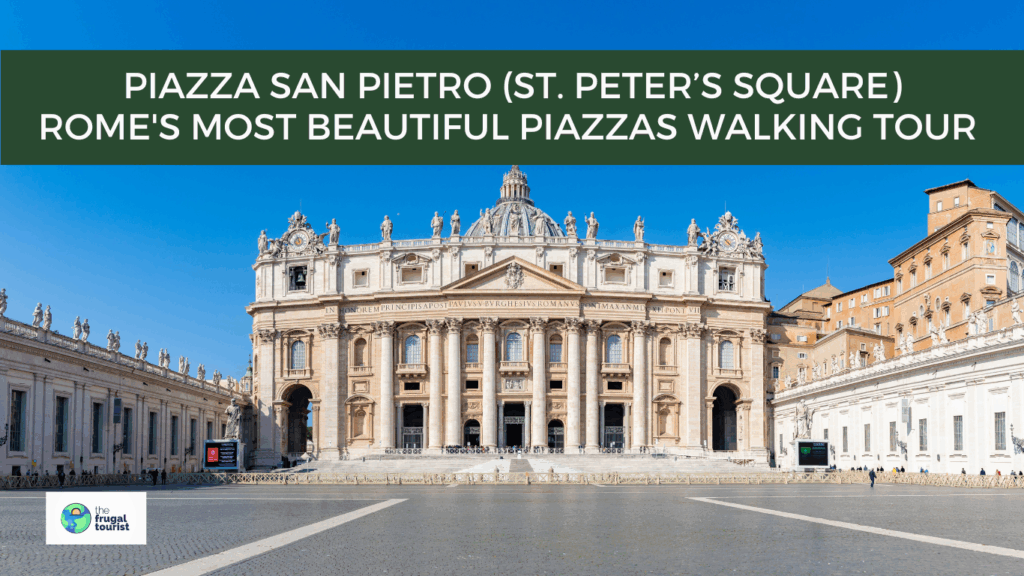
Insider Tip: Find the round marble discs on the pavement between the obelisk and the fountain. Standing on one of these points makes the quadruple rows of Bernini’s columns align perfectly, appearing as a single row—a true optical marvel!
Foodie Stop: Gelateria Old Bridge (Viale dei Bastioni di Michelangelo). A favorite among locals and tourists for generous portions of authentic, creamy gelato—a perfect treat after the Basilica.
Personal Note for Filipino Readers: If you’re craving a taste of home after this grand stop, you’ll be glad to know there’s a Jollibee location conveniently close by! It’s a fun, familiar connection right in the heart of Rome.
Head east out of St. Peter’s Square, walking down the central street, Via della Conciliazione.
This will take you directly toward the Tiber River.
Cross the river via Ponte Sant’Angelo, a beautiful bridge adorned with Bernini’s angel sculptures.
After crossing, continue straight onto Via di Panico, which will curve slightly right.
Keep following the signs for Piazza Navona, turning onto Via dei Coronari, until you reach the Piazza (Approx. 20-25 minute walk, 1.5km).
| Worth the Detour: Castel Sant’Angelo |
|---|
| Castel Sant’Angelo is a unique historical site that transformed from an ancient emperor’s tomb into a fortress and eventually a luxury palace for the Pope. It features the fascinating “Passetto,” a secret elevated escape route that connected the castle to the Vatican for use during emergencies. Best of all, a climb to the top offers a massive rooftop terrace with the most incredible views of St. Peter’s Basilica and the Rome skyline. |
Piazza Navona is a sublime Baroque Roman masterpiece, built on the site of the 1st-century Stadium of Domitian.
Its long, oval shape perfectly preserves the perimeter of the ancient athletic track, now a stage for stunning fountains and Palazzi.
It is a must-see for the powerful artistic rivalry between Bernini and Borromini, which played out across the square.
Sites Not to Miss: Bernini’s towering Fontana dei Quattro Fiumi (Fountain of the Four Rivers) and Borromini’s curved church, Sant’Agnese in Agone.
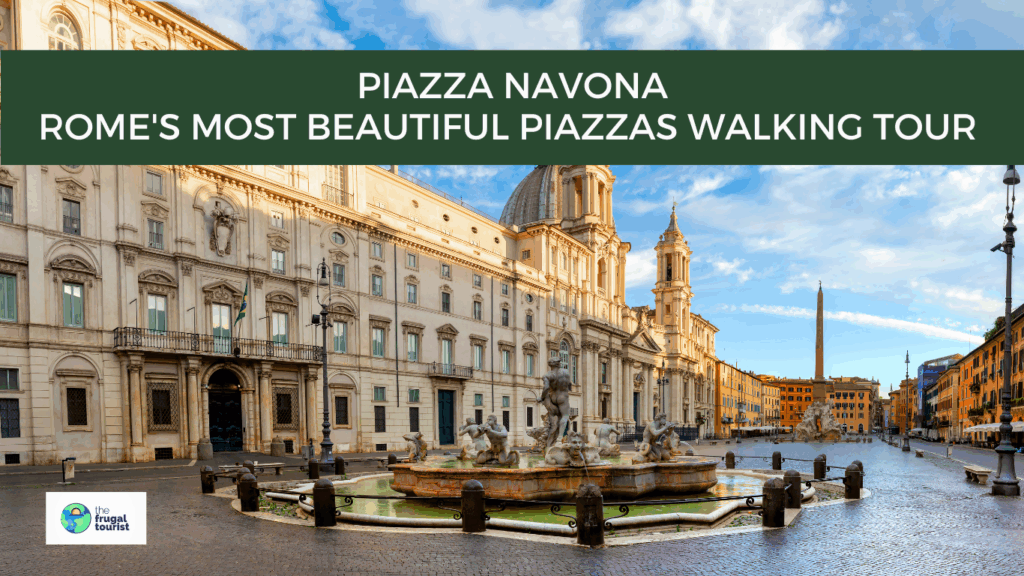
Insider Tip: Visit the small museum in the Stadium of Domitian, beneath the square, to see the ancient ruins that shaped the piazza’s unique shape. Grab a refreshing grattachecca (shaved ice) from a local vendor here in the summer.
Foodie Stop: Gelateria Frigidarium (Via del Governo Vecchio). Just a block north of the piazza, this spot is famous for its fresh gelato dipped in a dark or white chocolate shell that hardens instantly.
| Worth the Detour: Caravaggio Paintings |
|---|
| San Luigi De Francesci is a beautiful Baroque church located near Piazza Navona. Built in the 17th century, this church is known for its stunning architecture and artwork by renowned artists such as Caravaggio and Domenichino. One of the main attractions of San Luigi De Francesci is the Contarelli Chapel, which houses three famous paintings by Caravaggio. These include “The Calling of Saint Matthew,” “The Inspiration of Saint Matthew,” and “The Martyrdom of Saint Matthew.” Each painting tells a different story from the life of Saint Matthew, one of Jesus’ twelve apostles. This is a personal favorite and a pilgrimage I do whenever I visit the Eternal City. |
Walking Instructions to Piazza Campo de’ Fiori:
From the South end of Piazza Navona (near the Fountain of the Moor), exit onto Via del Circo Agonale and take the second left onto Via di Pasquino.
Follow this short street to Piazza di Pasquino, then continue south along Via dei Chiavari, which leads you directly into Piazza Campo de’ Fiori. (Approx. 5-7 minute walk, 500m)
Stop 3: Piazza Campo de’ Fiori
Unlike the formal Baroque style of its neighbors, Piazza Campo de’ Fiori (Field of Flowers) has a rugged, medieval history, formerly a place of public executions.
Today, it’s one of Rome’s most authentic squares, famous for its daily fresh food market and vibrant nightlife.
Its history is permanently marked by the imposing statue of Giordano Bruno, who was burned at the stake here in 1600.
Sites Not to Miss: The daily morning market (Mon-Sat) for fresh produce and spices, and the chilling, cloaked statue of philosopher Giordano Bruno.
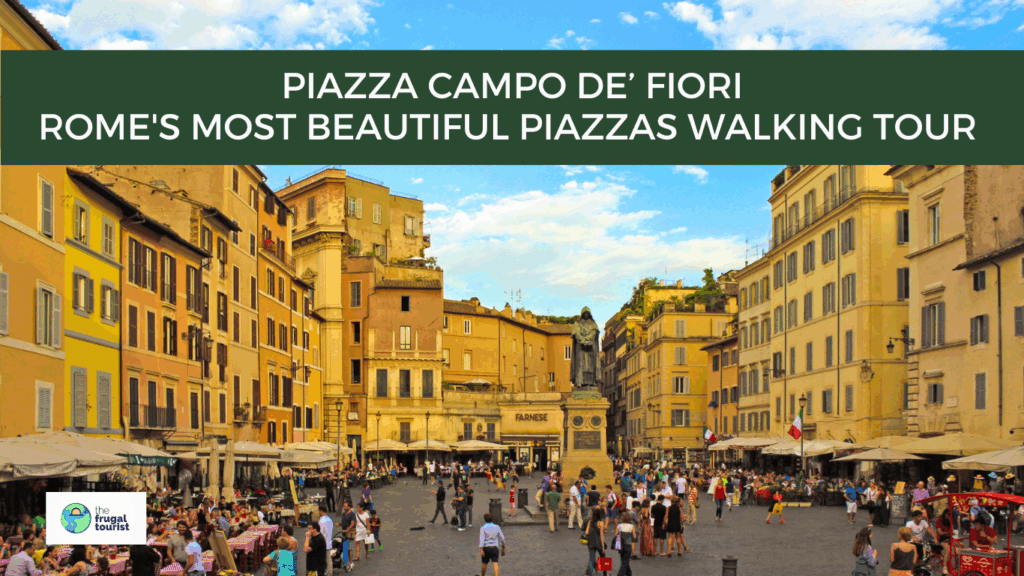
Insider Tip: While the market closes around 2 pm, the square truly comes alive in the late afternoon and evening, making it one of the best spots in Rome for an authentic aperitivo (pre-dinner drink).
Foodie Stop: Forno Campo de’ Fiori (in Piazza Campo de’ Fiori). This legendary bakery on the piazza is famous for its delicious pizza bianca (focaccia-style) and its pizza rossa (with tomato). Perfect for a midday snack!
Walking Instructions to Piazza della Rotonda:
From the North side of Campo de’ Fiori, exit onto Via dei Giubbonari.
Follow this street east until you hit Via Arenula, where you will cross and continue straight on Via del Monte della Farina.
Veer left onto Via delle Ceste, and shortly after, you’ll see the massive dome of the Pantheon guiding you into Piazza della Rotonda. (Approx. 10-12 minute walk, 800m)
Stop 4: Piazza della Rotonda (The Pantheon)
This piazza is essentially the waiting room for the magnificent Pantheon, my favorite Roman Empire site.
The square’s history is intrinsically linked to the Pantheon itself—a former Roman temple, now a church, with the largest unreinforced concrete dome in the world.
The piazza serves as a vibrant social meeting place, offering a dazzling contrast between ancient grandeur and modern Roman life.
Sites Not to Miss: The Pantheon itself, and the Fontana del Pantheon with its Egyptian obelisk, commissioned by Pope Clement XI.
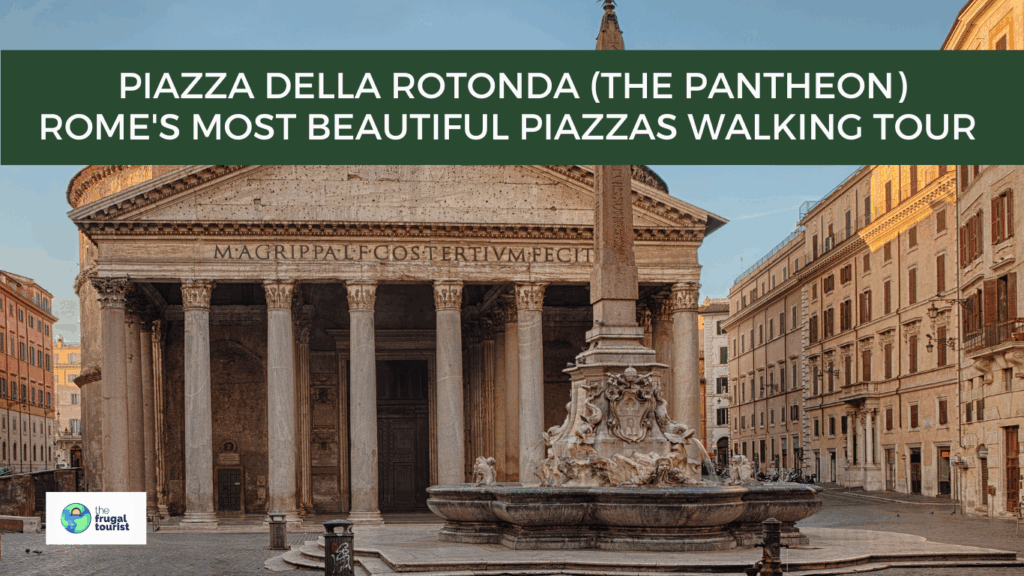
Insider Tip: Skip the overpriced cafe seating around the perimeter. Instead, grab a coffee-to-go at Tazza d’Oro (a legendary coffee shop just off the piazza) and stand in the square to admire the view like a local.
Foodie Stop: Giolitti (Via degli Uffici del Vicario). Walk two minutes north of the Pantheon for a scoop from Rome’s oldest and most famous gelateria. Don’t miss their iconic pistachio flavor!
| Worth the Detour: Michelangelo Sculpture |
|---|
| From the Pantheon, it’s just a short walk to the Church of Santa Maria Sopra Minerva. Here, you’ll discover one of Rome’s few Gothic churches. Outside, you’ll see Bernini’s elephant sculpture carrying an Egyptian obelisk. The obelisk dates to the 6th century BCE, during the reign of Pharaoh Apries, and was brought to Rome by the Romans. It was later placed on Bernini’s elephant base in 1667, symbolizing wisdom and strength. Inside, you’ll find a famous Michelangelo marble sculpture of “The Risen Christ” (Cristo della Minerva), completed in 1521 and depicting a naked Jesus carrying the cross. |
Walking Instructions to Piazza di Trevi:
Facing the Pantheon, take the street that runs immediately to the right (Via del Pantheon).
Follow this to Via dei Pastini, then to Via delle Muratte.
Keep an ear out for the sound of rushing water—it’s the universal beacon that leads you straight to the Trevi Fountain. (Approx. 7-10 minute walk, 500m)
Alternatively, you can take the long route, by making a detour on the following spots:
- Piazza di Pietra
- Chiesa di Sant’Ignazio
- Piazza Colonna
- Galleria Alberto Sordi
| Worth the Detour: Chisea di Sant’Ignazio and Piazza Di Pietra |
|---|
| Located just steps from the Pantheon, the Chiesa di Sant’Ignazio and Piazza di Pietra serve as essential stops, contrasting ancient history with Baroque artistry. Piazza di Pietra features the colossal columns of the ancient Temple of Hadrian embedded directly into a 17th-century wall, offering a stark reminder of Rome’s layered past. Just around the corner, Sant’Ignazio has recently become a viral sensation thanks to a strategically placed mirror that lets visitors capture perfect selfies against its breathtaking ceiling frescoes. This “Instagrammable” setup highlights the church’s famous optical illusions, including a “fake” dome that is actually a flat canvas painted to trick the eye. Together, these sites provide a captivating look at Roman ingenuity, blending imperial ruins with immersive artistic tricks that continue to dazzle modern crowds. |
| The Long Route to Trevi: Piazza Colonna and Galleria Alberto Sordi |
|---|
| Walking via Piazza Colonna and Galleria Alberto Sordi transforms the short transit between the Pantheon (or Chisea di Sant’Ignazio) and Trevi Fountain into a sightseeing highlight. In Piazza Colonna, you can admire the towering Column of Marcus Aurelius, an ancient victory monument featuring intricate relief carvings that spiral up its surface. Just across the street, the Galleria Alberto Sordi provides a stunning contrast with its elegant Art Nouveau architecture, stained-glass skylights, and mosaic floors. This route allows you to experience both imperial history and modern Italian style without deviating from your path. As you exit the Galleria, follow the crowds to Trevi. |
Stop 5: Piazza di Trevi (Trevi Fountain)
Piazza di Trevi is one of Rome’s most popular destinations, but its small size only enhances the stunning spectacle of the fountain, which takes up almost the entire square.
The Trevi Fountain is a dramatic Baroque masterpiece built at the terminus of the Aqua Virgo aqueduct, dating back to 19 BC.
It is a must-see for the sheer drama and the tradition of tossing a coin to ensure your return to Rome.
Sites Not to Miss: The Fontana di Trevi (Trevi Fountain), of course, and the tiny adjacent church, Santi Vincenzo e Anastasio a Trevi.
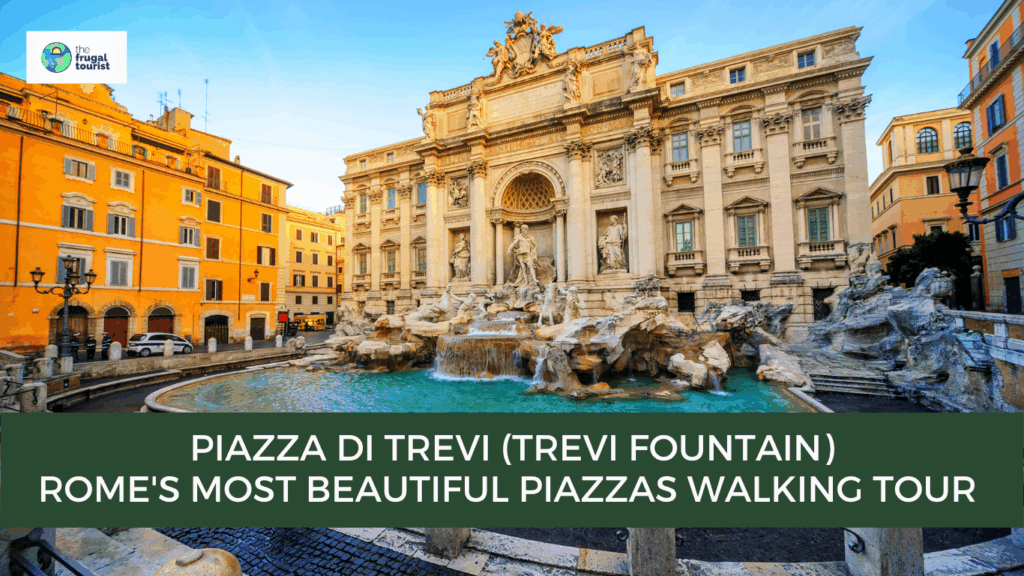
Insider Tip: Visit either early (before 8 am) or late (after 11 pm) to avoid the colossal crowds. The fountain is beautifully lit at night, offering a magical experience. Remember to toss your coin over your left shoulder!
Foodie Stop: Gelateria San Crispino (Via della Panetteria). Located just behind the fountain, this high-quality gelateria is known for its pure, natural flavors. They famously don’t use cones, as they believe the taste interferes with the purity of the gelato.
Walking Instructions to Piazza Barberini:
From Piazza di Trevi, head north on Via della Stamperia, which becomes Via del Tritone.
Continue along Via del Tritone (a major street) until you reach the large, busy intersection marked by a fountain in the middle.
This is Piazza Barberini. (Approx. 10-15 minute walk, 800m)
Stop 6: Piazza Barberini
Piazza Barberini is a vital link between the historic center and the grand boulevards of modern Rome, named after the influential Barberini family whose grand palace (Palazzo Barberini) sits nearby.
It is a mandatory stop to witness a unique sculptural work by Bernini that captures the spirit of the Baroque era.
Sites Not to Miss: Bernini’s breathtaking Fontana del Tritone (Triton Fountain), depicting the sea god blowing water from a conch shell. Also look for the smaller Fontana delle Api (Fountain of the Bees).
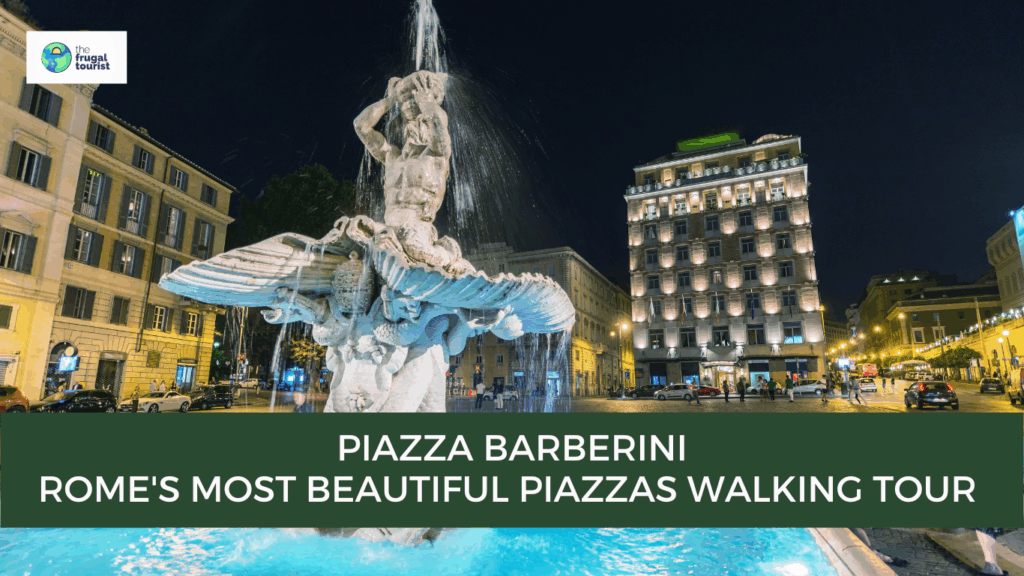
Insider Tip: While you’re here, take a slight detour to visit the Capuchin Crypt (via Vittorio Veneto), a macabre yet fascinating display of bones arranged artistically by Capuchin friars.
Foodie Stop: Pinsere (Via Flavia). Take a short detour northeast from the piazza to discover this tiny shop serving Roman pinsa, an ancient, easily digestible variation of pizza with a delicious oval shape and lighter crust.
Walking Instructions to Piazza di Spagna:
From Piazza Barberini, head northwest along Via Sistina (it goes slightly uphill).
This street runs straight for a few blocks and ends directly at the top of the Spanish Steps, which opens into Piazza di Spagna. (Approx. 5-7 minute walk, 500m)
Stop 7: Piazza di Spagna (Spanish Steps)
Piazza di Spagna is internationally famous for the monumental Scalinata (Spanish Steps), connecting the square below to the Trinità dei Monti church above.
The piazza’s name comes from the Spanish Embassy to the Holy See, which is located here.
It became a cultural hub in the 18th century, attracting poets and artists, and it remains a center for luxury shopping today.
Sites Not to Miss: The 138 Spanish Steps, the beautiful boat-shaped fountain, Fontana della Barcaccia (designed by Bernini’s father), and the view from the top overlooking Rome.
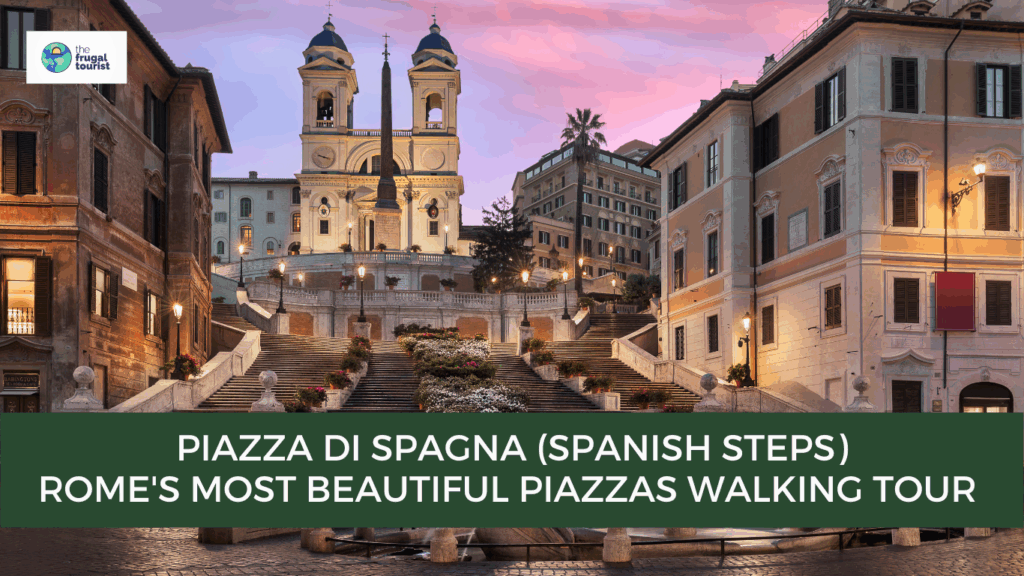
Insider Tip: The area is a fantastic spot for window shopping. To get a truly stunning perspective, take the small pathway to the left of the Trinità dei Monti church at the top of the steps and walk toward the Pincian Hill for another epic viewpoint.
Foodie Stop: Pompi (Via della Croce). Just a short stroll from the bottom of the steps, this spot is globally famous for serving one of the best traditional Tiramisu desserts in Rome. It comes in a little take-away box—perfect for eating while you stroll.
Walking Instructions to Piazza del Popolo:
From the top of the Spanish Steps (Piazza Trinità dei Monti), continue along the flat path called Viale della Trinità dei Monti/Viale dell’Obelisco until you reach the large balcony overlooking Piazza del Popolo.
Take the winding staircase or pathway down into the square.
This is one of my favorite hidden walks in Rome (Approx. 10-15 minute walk, 800m).
Stop 8: Piazza del Popolo
Piazza del Popolo (People’s Square) served for centuries as the main northern gateway into Rome, the first view of the city for countless travelers.
Designed by Giuseppe Valadier in the neoclassical style, it’s a vast oval ringed by churches and featuring a massive Egyptian obelisk.
It is a stunning example of coordinated urban planning.
Sites Not to Miss: The twin churches of Santa Maria dei Miracoli and Santa Maria in Montesanto, and the church of Santa Maria del Popolo, which holds masterpieces by Caravaggio.
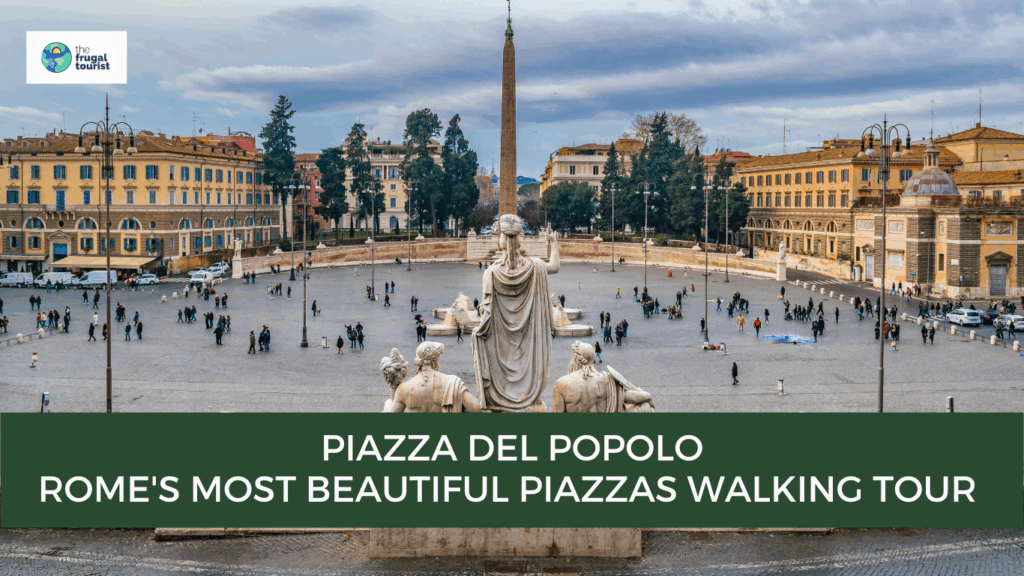
Insider Tip: The view from the Pincian Hill terrace (accessible via steps in the square, or the path you took from the Spanish Steps) at sunset is mandatory—it provides one of the most spectacular panoramas of Rome.
Foodie Stop: Pizzeria Ciro (Via del Corso). Located on the main street leading south from the piazza, Ciro serves excellent Neapolitan-style pizza by the slice, making it a quick and satisfying stop before moving on.
Public Transportation to Piazza Venezia & Piazza del Campidoglio:
From Piazza del Popolo to our next stop, walking is an option, but if it is too far for a single tour stop, public transport is available.
Take the Metro A Line from the nearby station Flaminio (just outside the piazza’s north gate) and ride it one stop south to Spagna.
From Spagna, you can take a bus (e.g., Bus 85 or 64) southbound on Via del Corso and get off at the Venezia stop.
Alternatively, take the Metro A to Termini, then switch to a bus/tram towards Piazza Venezia.
(Approx. 25-35 minutes total travel time.)
Stop 9: Piazza Venezia & Piazza del Campidoglio
Our second-to-last stop is a powerful combination of imperial and Renaissance history.
Piazza Venezia is dominated by the massive Monumento Nazionale a Vittorio Emanuele II (Il Vittoriano).
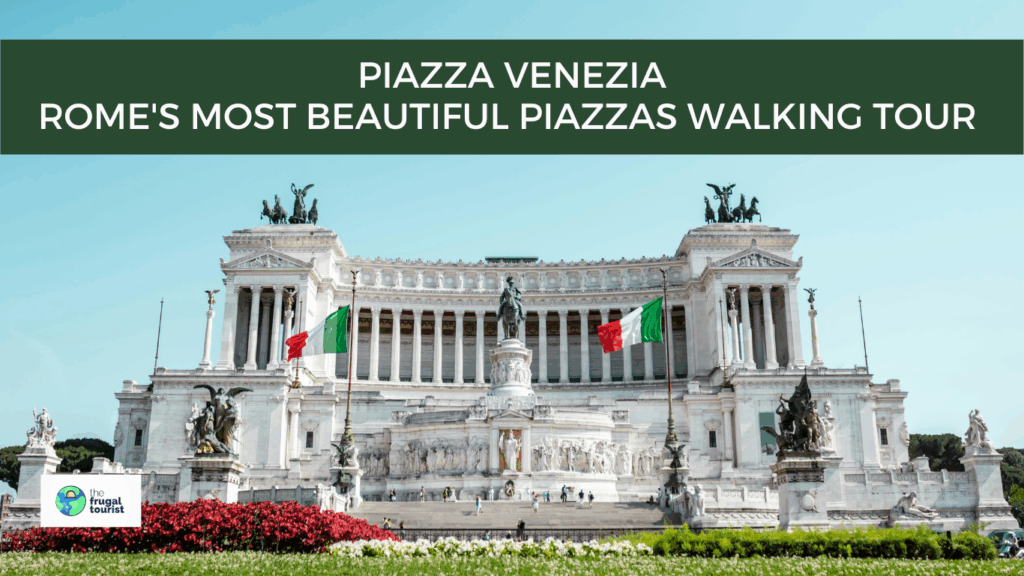
Just a short walk up the hill behind the monument, you’ll find Piazza del Campidoglio, the civic and religious heart of ancient Rome, stunningly redesigned by Michelangelo in the Renaissance.
Sites Not to Miss: The impressive scale of Il Vittoriano and the perfect symmetry of the steps and geometric pavement of Piazza del Campidoglio.
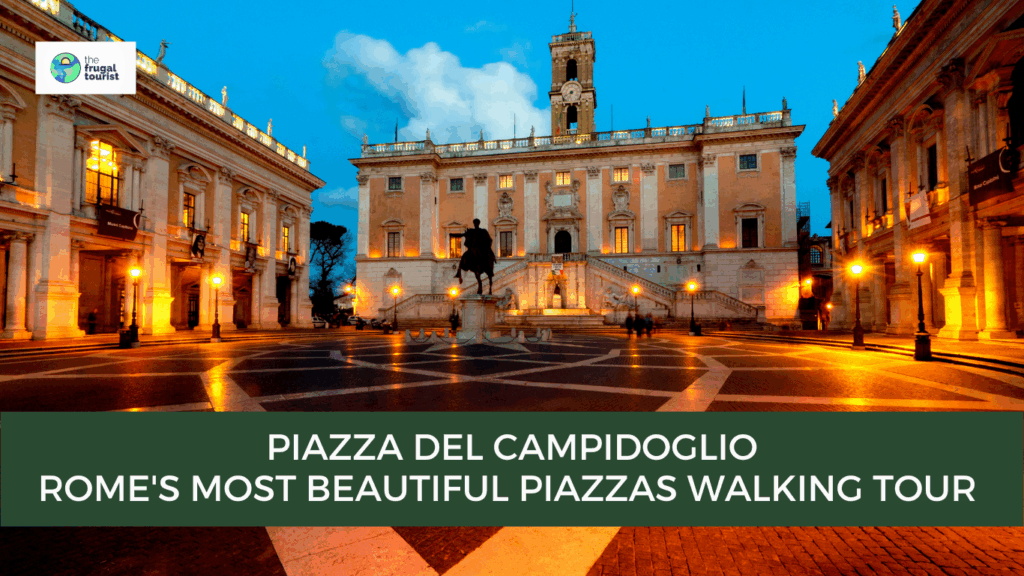
Insider Tip: Take the glass lift up to the panoramic terrace of Il Vittoriano for an incredible view stretching back over the entire route you just walked. Then, find a quiet moment of reflection in the silent, elevated beauty of the Campidoglio.
Foodie Stop: Trapizzino Testaccio (Various locations, but the nearby one on Via Giovanni Branca is great). This is a Roman street food hybrid: a pizza pocket shaped like a cone and filled with traditional Roman stews like coda alla vaccinara (oxtail) or pollo alla cacciatora.
Walking Instructions to Piazza del Colosseo:
Walk east from Piazza Venezia along Via dei Fori Imperiali.
This iconic boulevard cuts right through the heart of the Roman Forum and Imperial Fora ruins, leading you directly to the Colosseum. (Approx. 15-minute walk, 1km)
Stop 10: Piazza del Colosseo (The Colosseum)
While technically the area surrounding Rome’s most famous landmark, Piazza del Colosseo, is the magnificent conclusion to any Roman tour.
Dominated by the Colosseum, the largest ancient amphitheater ever built, this area is a must-see as it embodies the height of Roman imperial engineering and power.
It stood for centuries as the stage for gladiatorial games and public spectacles, and today, its ruins serve as a humbling monument to history.
Sites Not to Miss: The Colosseum, the Arch of Constantine (the best-preserved triumphal arch), and the adjacent Roman Forum and Palatine Hill.
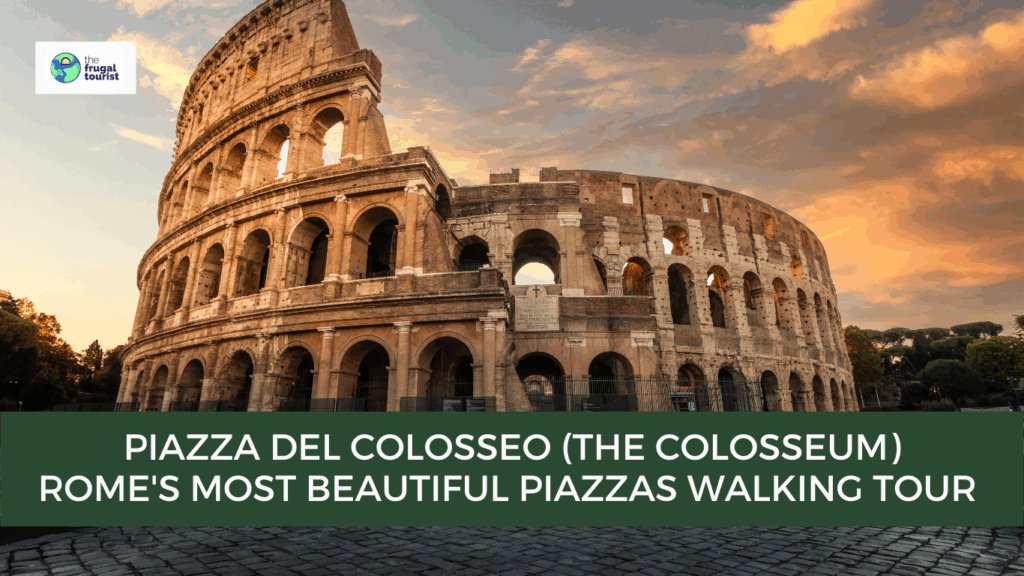
Insider Tip: To fully appreciate the scale and history, consider booking a guided tour that includes access to the Colosseum’s underground (the Hypogeum), where gladiators and animals prepared for the arena.
Foodie Stop: Pasta Chef Monti (Via Baccina). A short walk into the trendy Monti neighborhood (north of the Colosseum) will take you to this fantastic, casual spot serving up freshly made pasta dishes like Cacio e Pepe—a perfect celebratory end to your walking tour.
The Second Leg: Rome’s Foodie Piazzas (Optional Detour)
| Total Distance | Estimated Walking Tour Length |
| 2 miles | 1 hour |
If you have the energy after the grand tour, this second leg is the perfect way to end your Roman exploration.
It shifts from imperial monuments to local, authentic life, focusing on three amazing squares located in Rome’s most popular foodie areas for a truly memorable Italian meal.
Feel free to download (or share) the map below.
Walking Instructions (Colosseo to Monti):
From Piazza del Colosseo, walk north/northwest up Via Cavour (heading uphill).
Take a left onto Via dei Serpenti and then turn right onto Via della Madonna dei Monti.
The piazza is just a few steps ahead. (Approx. 10-12 minute walk)
Stop 11: Piazza della Madonna dei Monti
This charming, tree-lined square is the true heart of the Monti neighborhood, famous for its 17th-century fountain and the Church of Madonna dei Monti (Santa Maria ai Monti) that gives it its name.
It’s a favorite spot for locals, students, and artists to gather in the evenings, offering an authentic, bohemian Roman atmosphere away from the main tourist crowds.
It’s a must-see for experiencing contemporary Roman life in one of the city’s oldest and trendiest districts.
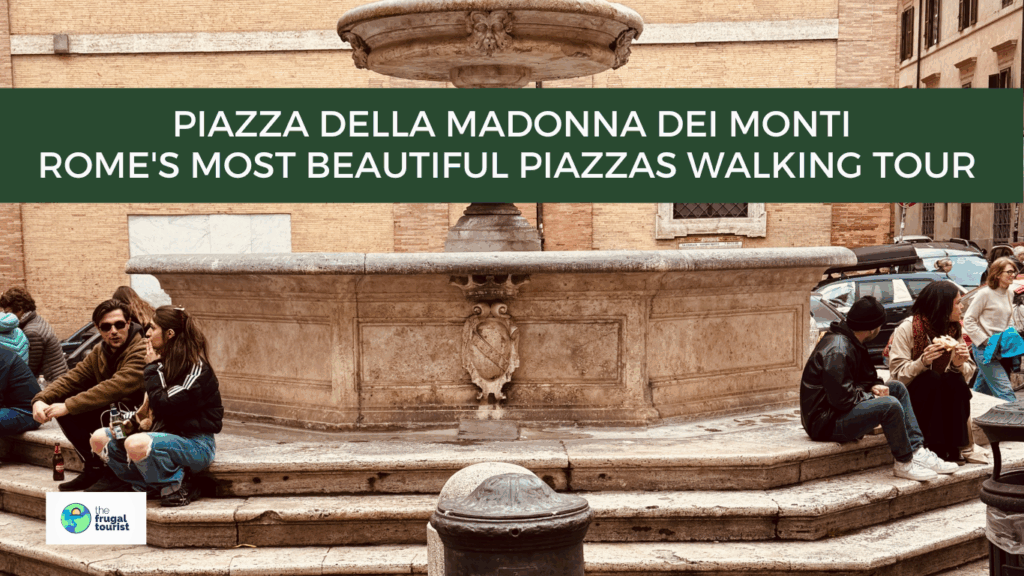
Insider Tip: This piazza serves as the vibrant heart of the Monti neighborhood. Secure a bottle of wine or a local beer, then claim a spot on the fountain steps to absorb the lively atmosphere and enjoy some people-watching as the sun dips below the horizon. Nearby, the church of San Pietro in Vincoli houses Michelangelo’s renowned sculpture of Moses, a true masterpiece.
Foodie Stop: Aromaticus Monti (Via Urbana, nearby). Head into Monti for fresh, healthy salads, gourmet sandwiches, and a focus on local, organic produce—a light, modern contrast to the heavy Roman classics.
Walking Instructions (Monti to Mattei):
From Piazza della Madonna dei Monti, head southwest down Via Cavour, crossing Via dei Fori Imperiali.
Continue through the back streets (Via dei Fornari) until you reach Largo di Torre Argentina.
From there, take Via Paganica into the Jewish Ghetto area, following signs toward the Fontana delle Tartarughe.
(Approx. 15-20 minute walk)
Stop 12: Piazza Mattei
A hidden gem nestled within the historic Jewish Ghetto, this small square is home to the elegant Fontana delle Tartarughe (Turtle Fountain).
This is a charming, often-overlooked Renaissance fountain, famous for the four playful bronze turtles added later by Bernini.
This square offers a quiet moment of beauty before entering one of Rome’s most historic and unique culinary neighborhoods.
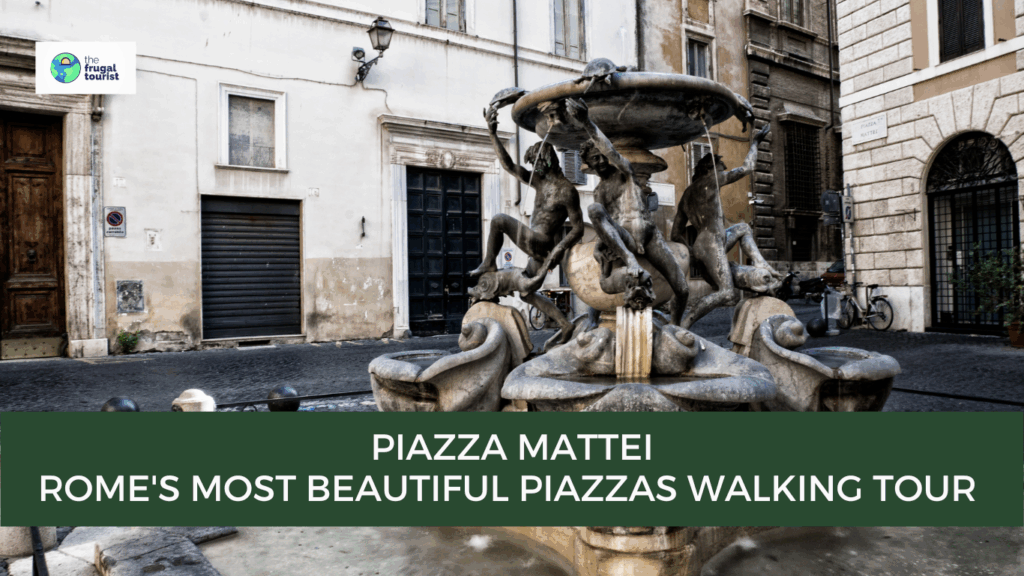
Insider Tip: Walk through the adjacent Jewish Ghetto and visit the Portico d’Ottavia and the Synagogue. This area is essential for its unique Roman-Jewish history, and it is a mandatory foodie destination for its cuisine.
Foodie Stop: Giggetto al Portico d’Ottavia (Via del Portico d’Ottavia). This restaurant is famous for serving traditional Roman-Jewish cuisine, including the iconic Carciofi alla giudia (fried artichokes), a dish you must try here.
Walking Instructions (Mattei to Trastevere):
From Piazza Mattei, head south/southwest toward the Tiber River, crossing via Ponte Fabricio (the oldest, continuously used bridge in Rome, dating to 62 BC) onto Tiber Island (Isola Tiberina).
Cross the island and take Ponte Cestio into Trastevere.
Head straight up Via della Lungaretta, which leads you directly to the piazza.
(Approx. 10-15 minute walk)
Stop 13: Piazza di Santa Maria in Trastevere
The final stop of the second leg is the famously bohemian heart of the Trastevere neighborhood.
This piazza is celebrated for its stunning church, Santa Maria in Trastevere, and its lively, bubbling street scene—it’s the ultimate place to end your evening with dinner.
The massive church and its beautiful fountain are lit spectacularly at night, providing a magical backdrop.
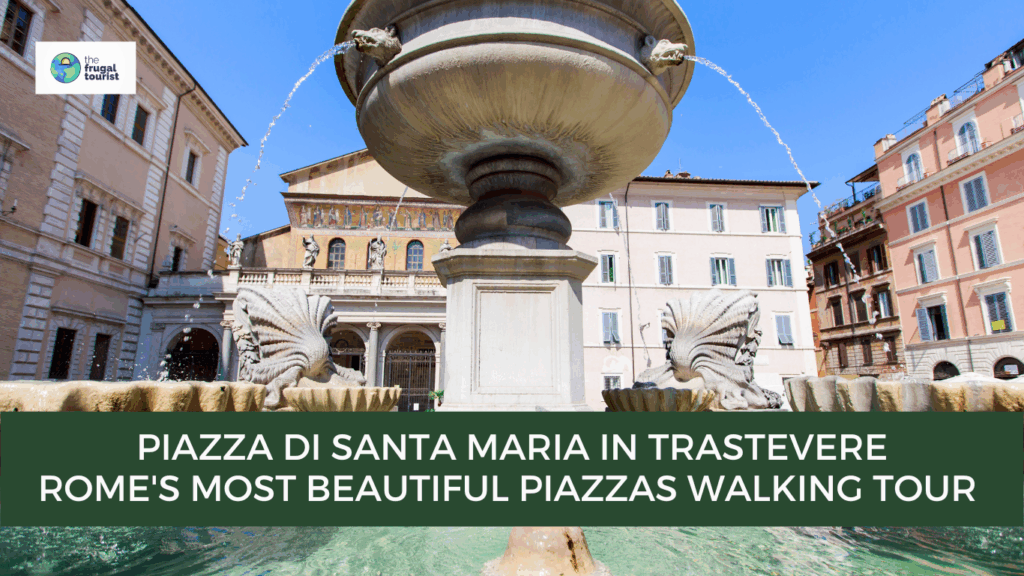
Insider Tip: Visit the basilica Santa Maria in Trastevere to see its incredible 12th-century mosaics, especially the golden ones glittering in the apse. After dinner, walk the charming alleyways of Trastevere, which are far quieter and more romantic than the main piazza.
Foodie Stop: Tonnarello (Via della Paglia). Located right near the piazza, this hugely popular yet authentic restaurant offers classic Roman pasta dishes like Cacio e Pepe and Amatriciana in a lively, traditional setting—the perfect celebratory final meal!
Essential Roman Travel Tips
Rome is generally safe, but its beauty attracts crowds, and where there are crowds, there are opportunists.
- Watch for Pickpockets: Especially on crowded buses (like the 64 or 85) and in dense tourist areas like the Trevi Fountain and the Colosseum. Wear backpacks on your front and keep valuables secured.
- Hydrate: Rome is hot! Bring a reusable water bottle. You can refill it for free at the Nasoni (small public drinking fountains) found all over the city.
- Wear Comfy Shoes: This is a serious walking tour, totaling well over
even with the metro shortcut. Leave the stilettos at home!
- Buy Bus/Metro Tickets in Advance: Tickets are valid for both metro and bus. Purchase a batch from a Tabacchi (T-sign) shop or a metro station for convenience, as you can’t buy them directly from the driver/on the metro.
Final Thoughts
This marathon tour is a journey through nearly 2,000 years of Roman artistic, religious, and political evolution, experienced at the perfect pace of a local.
Every piazza tells a chapter of the city’s story, culminating in the awe-inspiring presence of the Colosseum.
Go slow, savor that gelato, and don’t forget to look up—you’re literally walking through history!
Let me know what your favorite piazza is in the comments.
ADVERTISER DISCLOSURE: The Frugal Tourist is part of an affiliate sales network and receives compensation for sending traffic to partner sites, such as MileValue.com. This compensation may impact how and where links appear on this site. This site does not include all financial companies or all available financial offers. Terms apply to American Express benefits and offers. Enrollment may be required for select American Express benefits and offers. Visit americanexpress.com to learn more. All information about the American Express Schwab Platinum has been collected independently by The Frugal Tourist.
EDITORIAL DISCLOSURE: Opinions, reviews, analyses & recommendations are the author’s alone and have not been reviewed, endorsed, or approved by any of these entities.
USER-GENERATED CONTENT DISCLOSURE: The comments section below is not provided or commissioned by the bank advertiser. Responses have not been reviewed, approved, or otherwise endorsed by the bank advertiser. It is not the bank advertiser’s responsibility to ensure all questions are answered.