ADVERTISER DISCLOSURE: The Frugal Tourist is part of an affiliate sales network and receives compensation for sending traffic to partner sites, such as MileValue.com. This compensation may impact how and where links appear on this site. This site does not include all financial companies or all available financial offers. Terms apply to American Express benefits and offers. Enrollment may be required for select American Express benefits and offers. Visit americanexpress.com to learn more. All information about the American Express Schwab Platinum has been collected independently by The Frugal Tourist.
EDITORIAL DISCLOSURE: Opinions, reviews, analyses & recommendations are the author’s alone and have not been reviewed, endorsed, or approved by any of these entities.
As many of you know, I am currently recovering from heart bypass surgery.
Part of my rehabilitation involves getting my steps in, and honestly, there is no better gym than the streets of New York City.
Walking is fantastic for rebuilding cardiovascular endurance, but it’s much more fun when you have fascinating history and delicious smells around every corner.
I love this walk because it immerses you in the vibrant resilience of two of New York’s most iconic immigrant communities, offering a rich sensory experience without a high price tag.
The terrain is mostly flat and accessible, making it an ideal recovery route where you can build endurance while exploring history, culture, and community spirit.
It is proof that a journey to better health can be just as engaging and colorful as the city itself.
NYC Walking Tour #3 Stats
Total Distance:
Approx. 2 miles
Estimated Time:
2 – 3 hours (Allow time for exploring different restaurants)
Step Count Goal:
~4,500 steps
Highlights of This Chinatown and Little Italy Walk
Two Worlds in One Walk: Experience the dramatic shift from the bustling markets of Chinatown to the old-school charm of Little Italy in just a few steps.
Hidden History: Visit the oldest row house in NYC and walk down the infamous “Bloody Angle” on Doyers Street.
Cultural Immersion: Watch locals play traditional instruments in Columbus Park and see the largest golden Buddha statue in the city.
Recovery-Friendly Terrain: Enjoy a mostly flat route that is easy on the knees and heart, with plenty of benches for resting along the way.
Frugal Wins: See world-class history, architecture, and community life for free. Spending money on dumplings or cannoli is entirely optional!
Where I Stayed Using Hyatt Points
Before we lace up our shoes, let’s talk points!
Being “The Frugal Tourist” means I love luxury, but I hate paying full price for it.
I set up base camp at Hotel 50 Bowery in the middle of NYC’s Chinatown.
Typically, a hotel this central costs a fortune.
However, I booked a night here using 17,000 World of Hyatt points.
It put me right in the middle of the action without hurting my wallet, proving once again that credit card points are the best travel companion.
If you need tips on how to leverage credit card points for nearly free travel, feel free to join us in our free Travel Miles and Points Facebook Group community.
Join Our Free Travel Miles & Points Facebook Group
Join Our Free Travel Miles & Points Facebook Group
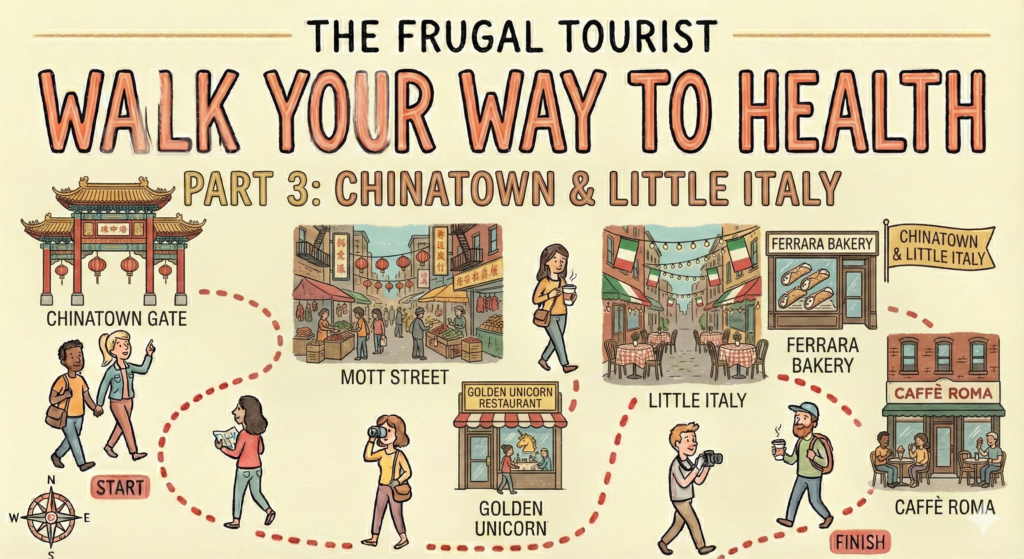
Map: New York City Walking Tour #3: Chinatown & Little Italy
Feel free to share or download the map for this NYC walking tour
Getting to the Starting Point
Since this is a recovery walk, we want to save our energy for the tour itself, not the commute.
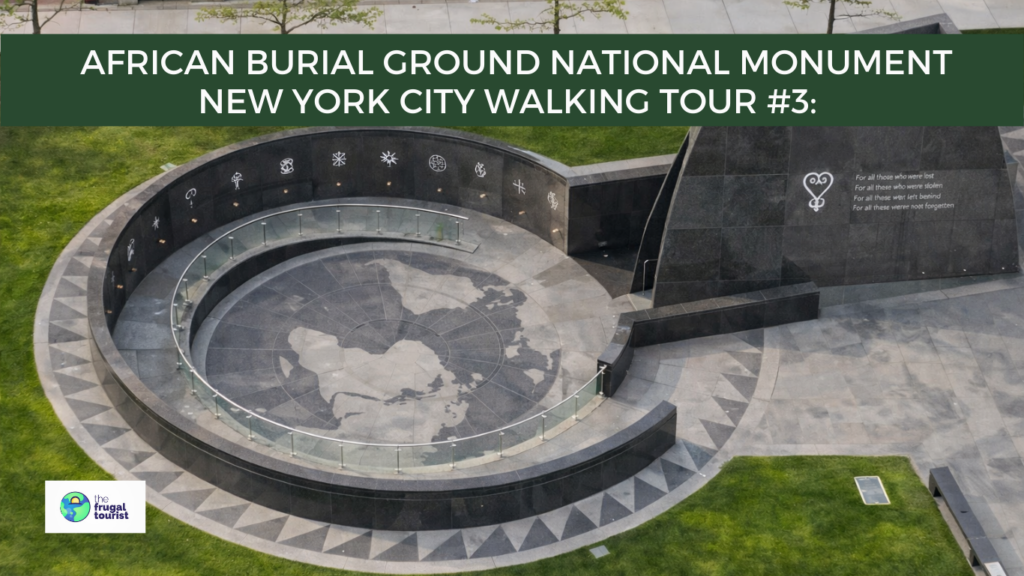
Our starting point is the African Burial Ground National Monument at 290 Broadway.
Subway (The Accessible Choice):
Take the 4, 5, or 6 train to Brooklyn Bridge–City Hall.
Health Tip: This station is one of the few in the area with an elevator (located near Reade St. & Centre St.), which is a lifesaver if you are avoiding stairs. It is just a 5-minute flat walk to the monument from here.
Note: The “Chambers Street” station is closer on the map but often involves many stairs, so stick to the City Hall stop for a smoother arrival.
Bus (The Scenic Route):
If you want to avoid the subway entirely, the M5, M15, or M103 buses all stop within a block or two of the site. Plus, you get a nice sightseeing tour of the city on the way down!
Restrooms: Where to Go For Free
Chinatown and Little Italy can be tricky for finding public restrooms, so here is your strategic plan.
The “Gold Standard” (Stop 1): African Burial Ground Visitor Center
Why: Before you start walking, use the facilities here! They are indoors, secure, and usually very clean. You have to go through airport-style security to enter the building, which keeps them pristine.
The “Public Option” (Stop 2): Columbus Park Pavilion
Why: There are public restrooms in the park pavilion. They are generally “acceptable” for a public park, but bring your own hand sanitizer just in case.
The “Library Hack” (Stop 3): Chatham Square Library
Why: Located at 33 East Broadway (near the Kimlau Arch), this public library is a great backup. It’s free, climate-controlled, and usually quieter than the park.
Note: Restrooms are sometimes locked, so you may need to ask a librarian for the key.
Little Italy Warning:
Free public restrooms are almost non-existent in Little Italy.
The Strategy: Use the restrooms in Chinatown (Stops 1–3) before you cross into Little Italy. If you are desperate while on Mulberry Street, your best frugal bet is to buy a small espresso ($3) or a cannoli at a place like Ferrara Bakery to become a paying customer.
Best Time to Visit NYC for Walkers
Since this itinerary relies heavily on being outdoors, timing your visit is crucial.
The Sweet Spot (Spring & Fall): The months of April–May and September–October are ideal. The temperatures are crisp (perfect for keeping your heart rate steady), the humidity is low, and the foliage in the parks provides a beautiful backdrop.
Summer Caution: NYC in July and August can be stifling. The concrete radiates heat, and the humidity can be taxing on the body. If you visit then, walk early in the morning (before 9 AM) to beat the heat.
Winter Warning: While hotel rates are lower in January and February, the wind chill can be brutal. If you walk in winter, thermal layers are non-negotiable.
Pro-Tip: Cash is King
Cash is king in these neighborhoods!
Many of the best restaurants are strictly cash-only.
Be sure to carry a stack of small bills ($1s and $5s) so you don’t miss out on these deals.
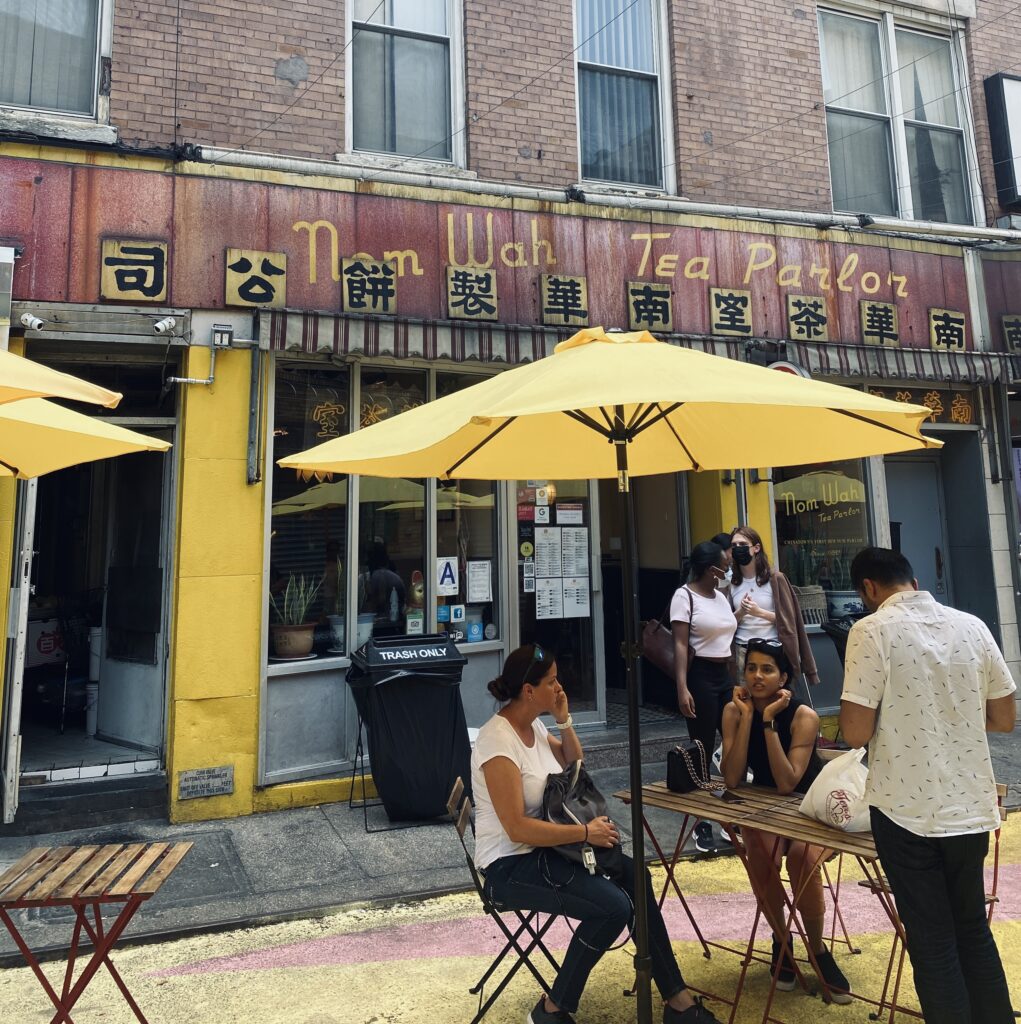
Also, check payment policies before you sit down; the legendary Nom Wah Tea Parlor, for example, only accepts cash or American Express
Don’t miss Nom Wah Tea Parlor
New York City Walking Tour Part 3: Chinatown & Little Italy
A. African Burial Ground National Monument
We are starting our walk just outside the main bustle of Chinatown at a deeply significant site.
The African Burial Ground is the oldest and largest known excavated burial ground in North America for both free and enslaved Africans.
It was rediscovered in 1991 during construction, and today, it serves as a peaceful and solemn memorial.
The site includes an outdoor memorial and an interpretive center that tells the story of the African contribution to building colonial New York.
In the 1990s, the General Services Administration (GSA) was building government offices when human remains were found 25-30 feet underground. Who were these people and why were they buried here? This discovery led scientists, historians, and the public to study a long-forgotten chapter in New York’s history when enslaved Africans helped build New Amsterdam (the colony’s name before it changed to New York). African Burial Ground National Monument honors these Africans’ memory and contributions. Their spirit continues to guide visitors’ understanding of enslavement in New York City’s colonial history.
African Burial Ground National Monument, New York City
Insider Tip: Visit the indoor visitor center (it’s free!) to see the exhibits before walking through the outdoor memorial. It gives you much-needed context. The visitor center, which is often missed by visitors, is located at 290 Broadway.
Why Visit: It is a powerful reminder of NYC’s hidden history and provides a quiet, reflective moment before we hit the busy streets of Chinatown.
Worth the Detour:Mmuseumm
Where: 4 Cortlandt Alley (tucked in a freight elevator shaft).
The Secret: It is one of the smallest museums in the world, displaying quirky modern artifacts (like “fake vomit from around the world” or “objects left in immigrants’ pockets”).
Frugal/Health Win: It’s often free (suggested donation) and you view it from the street 24/7 through viewing windows. It requires zero walking once you are there!
B. Columbus Park
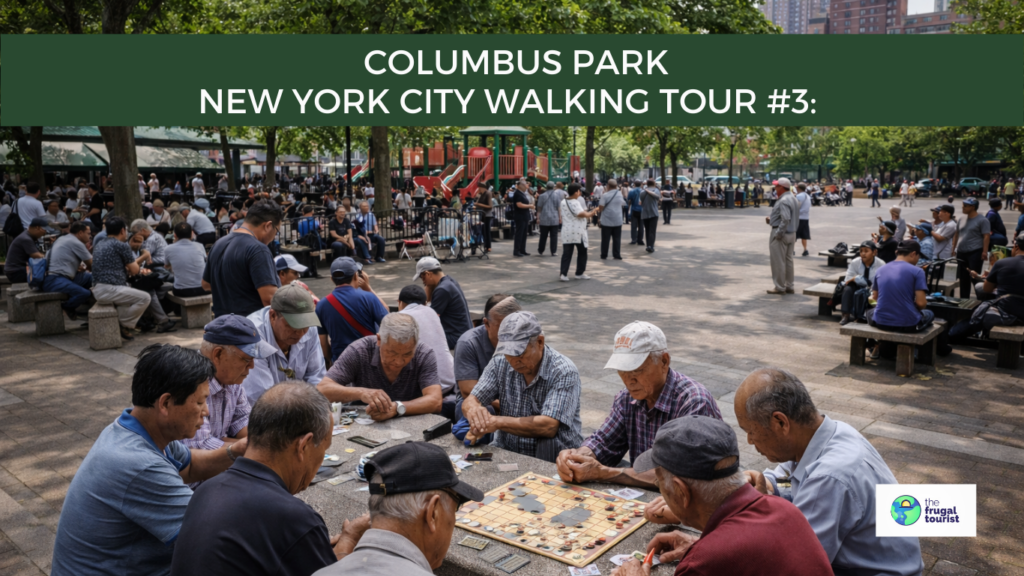
If you want to see the “living room” of Chinatown, this is it.
Columbus Park is where the local community comes together.
On any given morning or afternoon, you will see groups of seniors playing intense games of Xiangqi (Chinese chess) or cards, musicians playing traditional Chinese instruments, and people practicing Tai Chi.
It is vibrant, loud, and full of life.
This area used to be the center of the notorious “Five Points” neighborhood (seen in the movie Gangs of New York), but today it is a safe and happy community hub.
Insider Tip: There are plenty of benches here. Since I am pacing myself post-surgery, I like to sit here for 10 minutes to just people-watch and listen to the music.
Why Visit: It offers the most authentic glimpse into the daily lives of the residents who call this neighborhood home.
Worth the Detour:Mosco Street
Where: Connecting Mott and Mulberry (near Columbus Park).
The Secret: It’s a tiny, steep hill that used to be filled with tea shops. Now, it’s home to Fried Dumpling (an iconic cheap eat spot). Walking down this narrow alley feels like stepping back 100 years.
Pro-Tip: As you walk up Mosco Street, from Columbus Park to Mott, make sure to look back for stunning views of the One World Trade Center.
C. Kimlau Square & Chatham Square
Chatham Square is a major intersection that acts as a gateway where several streets meet.
It is chaotic and busy, but if you look closely, you’ll see the Kimlau Memorial Arch, which honors Chinese-Americans who died in service to the US.
Just a short detour from the square is the First Shearith Israel Cemetery.
It is the oldest Jewish cemetery in New York, dating back to 1683.
It is a tiny, quiet pocket of history tucked away behind a fence, contrasting sharply with the busy traffic nearby.
Insider Tip: You usually cannot enter the cemetery itself, but you can get a great view of the ancient gravestones from the sidewalk on St. James Place.
Why Visit: It shows the incredible layers of immigration history in the Lower East Side, proving that this area has been a melting pot for centuries.
Chatham Square
Worth the Detour: Confucius Plaza
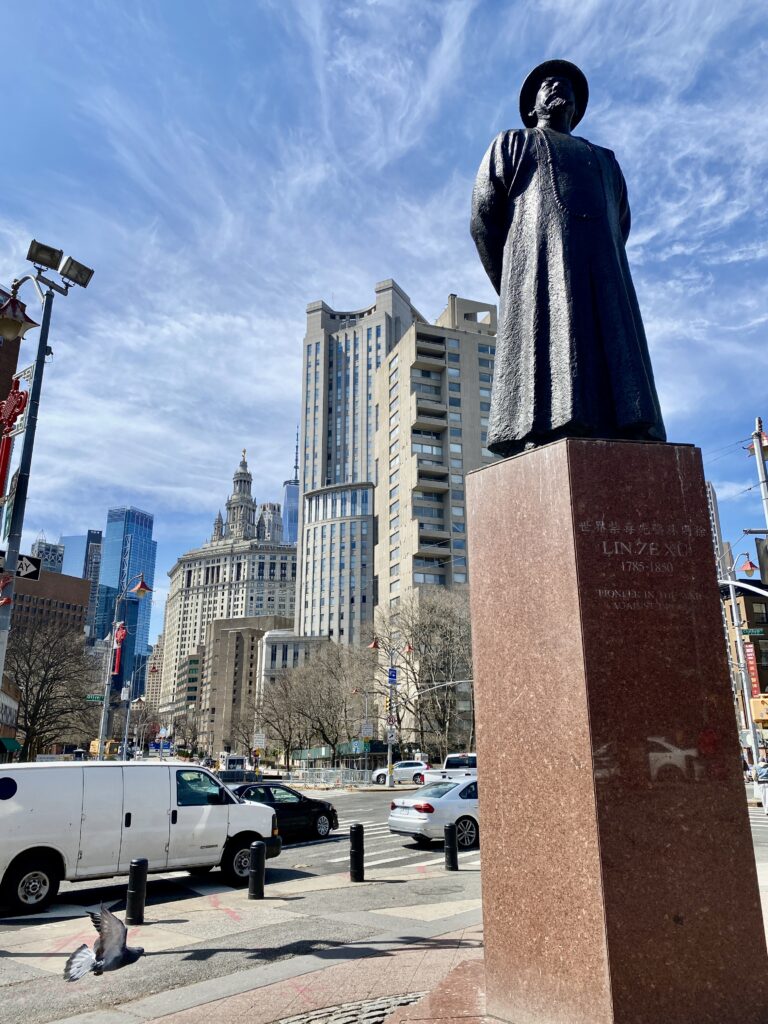
The plaza features a 15-foot bronze statue of Confucius, sculpted by Liu Shiming.
It was presented to the city in 1976 by the Chinese Consolidated Benevolent Association to commemorate the U.S. Bicentennial and stands as a significant symbol of the neighborhood’s cultural identity and the Confucian values of wisdom and peace.
Walk up to the statue and read the inscription on the marble base.
It features a famous proverb about the “Great Harmony,” which envisions a world where “the sick and the disabled are well cared for.”
As someone recovering from surgery, I found this ancient message of community care incredibly touching.
D. Doyers Street and Mott Street
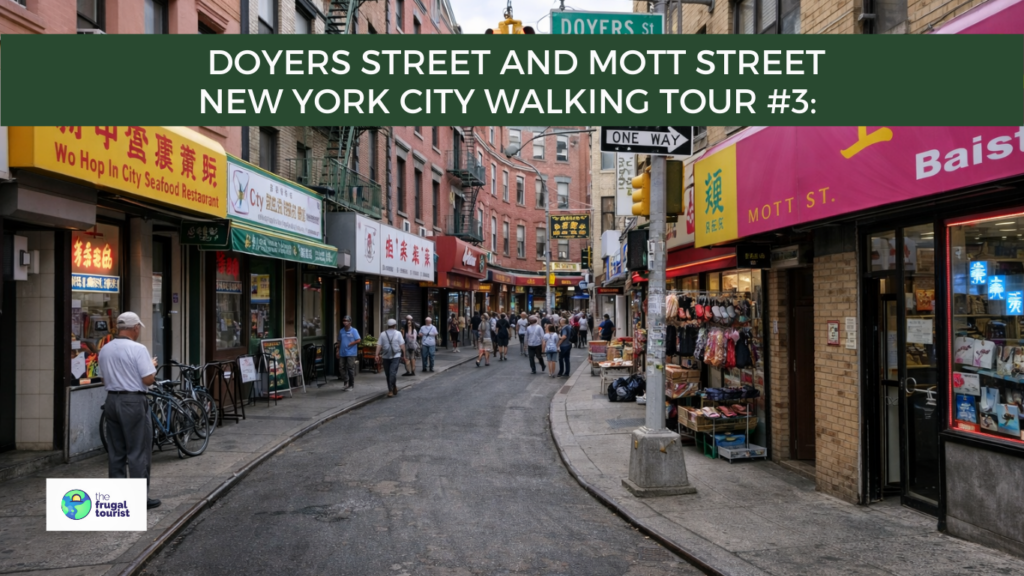
Mott Street is the main vein of Chinatown, packed with souvenir shops, vegetable markets, and fishmongers.
It is crowded and sensory overload in the best way.
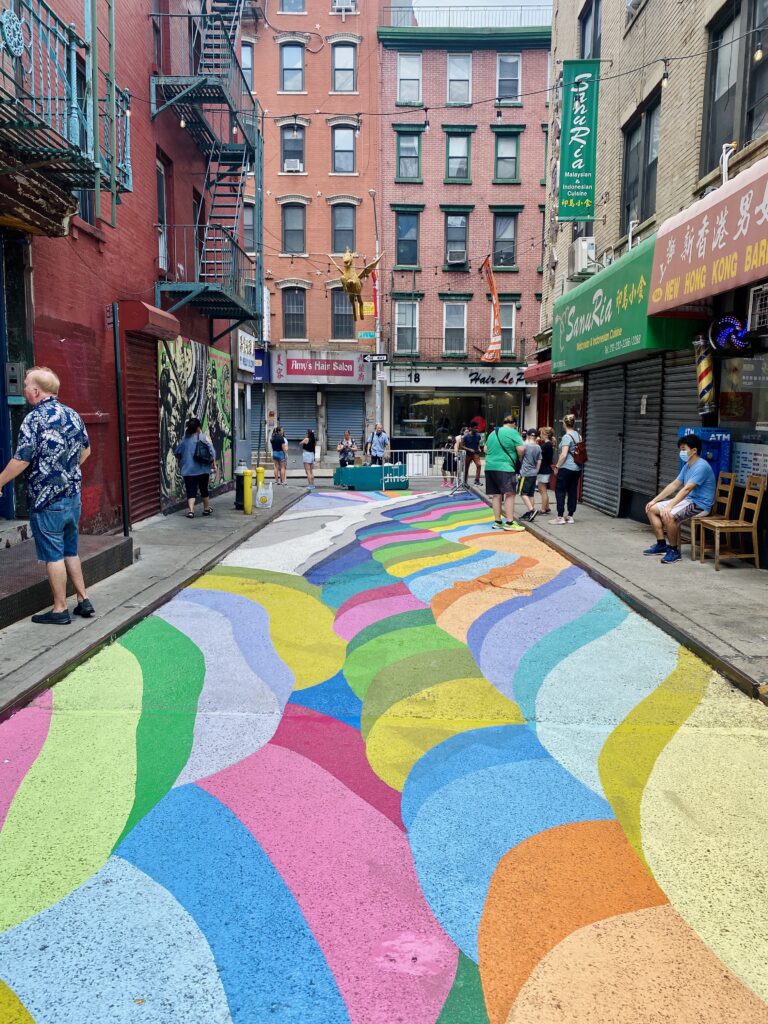
Then, turn onto Doyers Street, a sharp, crooked street once known as the “Bloody Angle” because of gang battles in the early 1900s.
Today, Doyers Street is colorful and safe.
It is also famous for “Barber’s Row.”
You will notice basement level after basement level of barber shops offering very cheap haircuts.
It’s a unique cultural quirk of the street!
Insider Tip: While on Doyers Street, stop at Nom Wah Tea Parlor. It opened in 1920 and is the oldest dim sum parlor in NYC. It’s a great place to sit down for a “heart-healthyish” portion of shrimp dumplings. Only cash and Amex are accepted.
Why Visit: The visual contrast between the straight avenues of Uptown and the winding, narrow streets here makes you feel like you’ve traveled to a different continent.
Doyers Street
E. Edward Mooney House
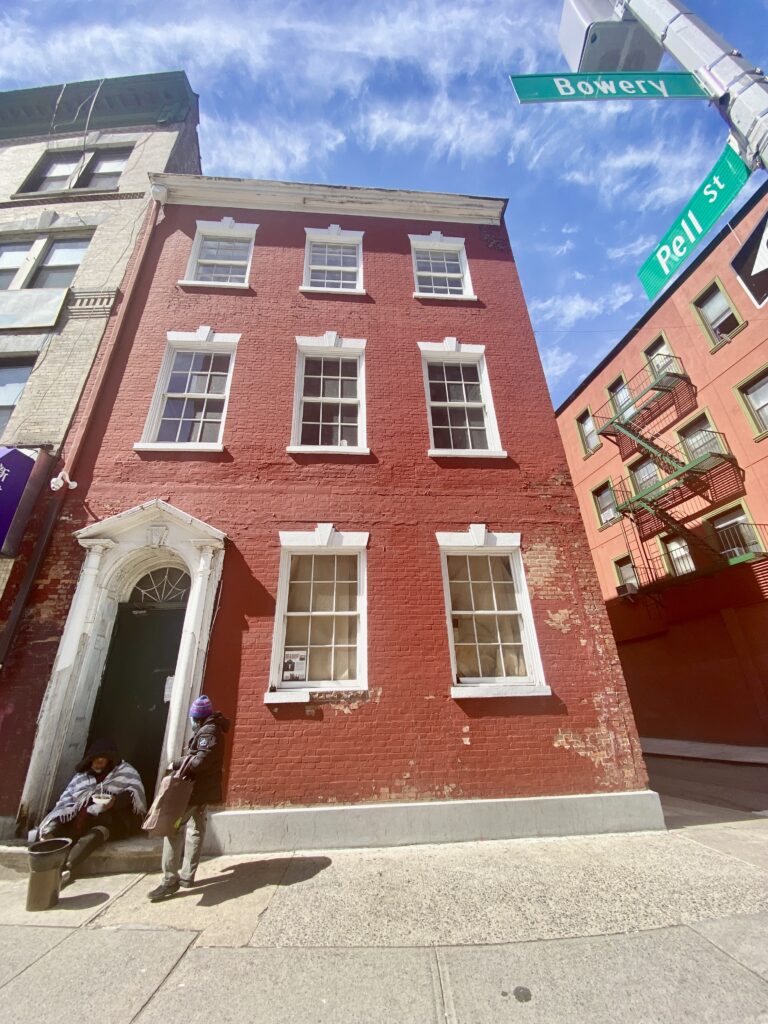
Located at the corner of Bowery and Pell Street, the Edward Mooney House is a true survivor.
Built in 1785, it is the oldest surviving row house in New York City.
It was built just after the Revolutionary War!
Over the centuries, it has been a wealthy private home, a hotel, a brothel, and now a bank.
It is a brick building that looks modest, but it has witnessed the entire transformation of the city from the very beginning.
Insider Tip: It is currently a bank branch, so you can actually walk into the lobby during business hours to take a peek, though the exterior is the main attraction.
Why Visit: It connects you directly to the post-Revolutionary War era of New York, a rare find in a city that constantly knocks down old buildings.
F. Mahayana Buddhist Temple
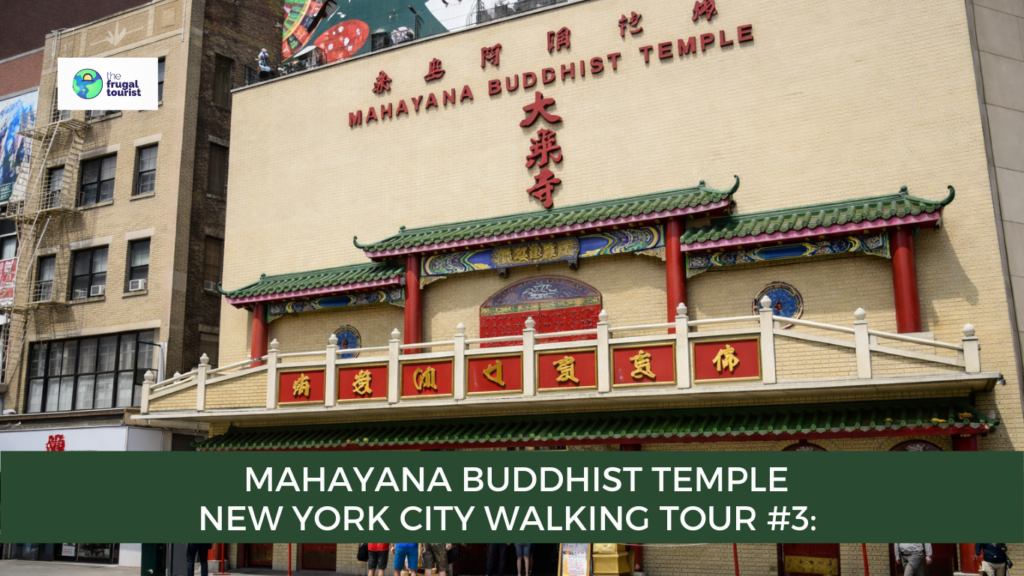
Right near the Manhattan Bridge entrance, you will find this peaceful temple.
The main attraction here is the golden Buddha statue, which is 16 feet high—the largest in the city.
The temple provides a stark contrast to the noisy traffic outside.
The interior is filled with illustrations of the life of Buddha and it smells of incense.
It is a welcoming place for visitors of all faiths to step in and find a moment of calm.
Insider Tip: For a small donation (usually a dollar), you can get a fortune scroll. It’s a fun, low-cost souvenir.
Why Visit: It’s a beautiful cultural experience and a perfect “rest stop” for the mind and body during a long walk.
G. Manhattan Bridge Arch
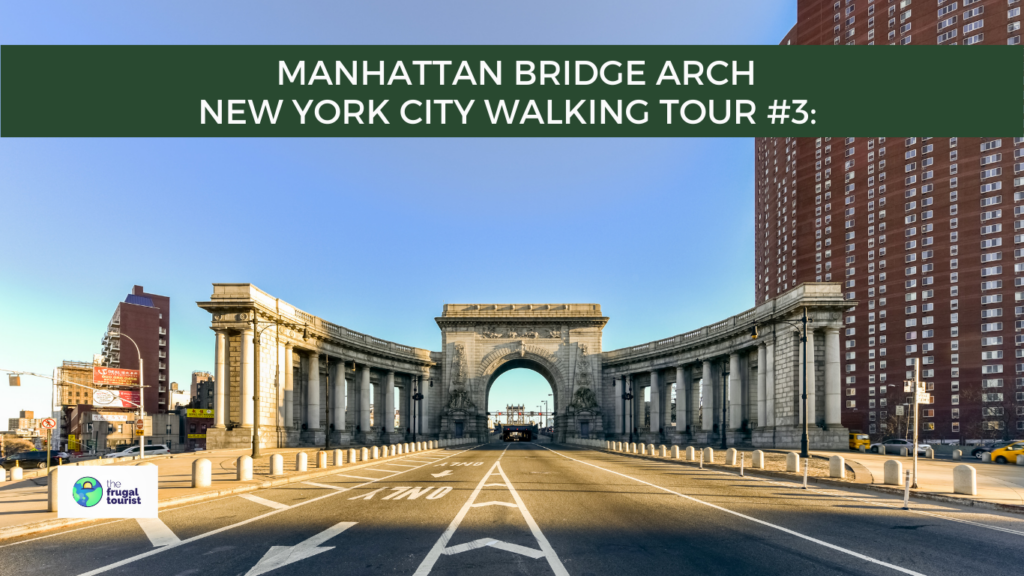
While the Brooklyn Bridge gets all the fame, the entrance to the Manhattan Bridge is incredibly grand.
This massive arch and colonnade were inspired by the triumphal arches in Paris and Rome.
It features beautiful sculptures and creates a dramatic backdrop for photos.
It’s located right at the foot of the bridge and serves as a majestic, if slightly gritty, entrance to Chinatown.
Insider Tip: This is a great spot for photography. If you stand across the street, you can frame the arch with the traffic and the bustling energy of the city.
Why Visit: The architecture is stunning and often overlooked by tourists who just focus on the Brooklyn Bridge.
H. Museum at Eldridge Street
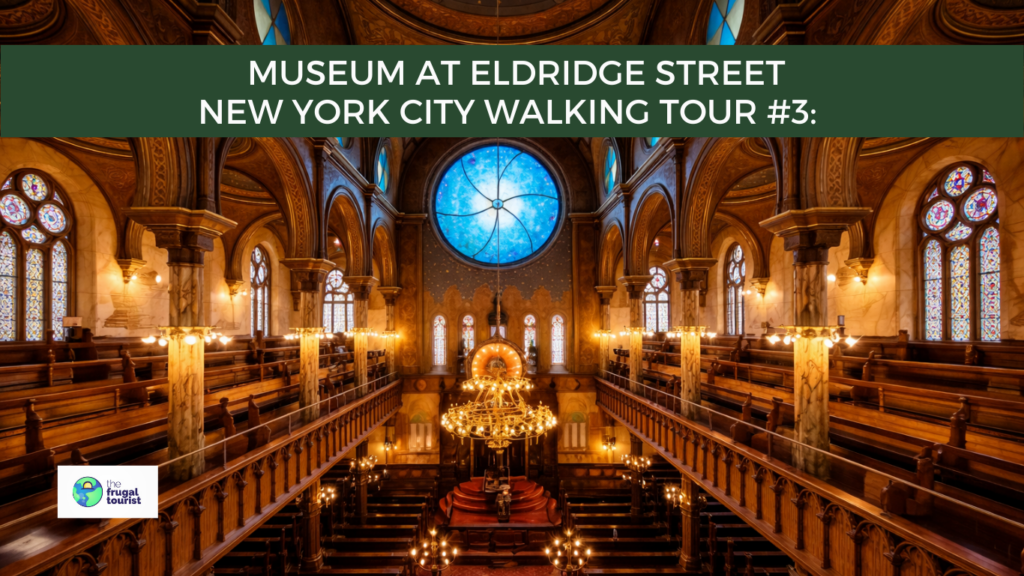
The Museum at Eldridge Street is housed in the Eldridge Street Synagogue, which opened in 1887.
It is a National Historic Landmark and was the first great house of worship built in America by Jewish immigrants from Eastern Europe.
The restoration here is jaw-dropping, especially the massive stained-glass window.
Insider Tip: Check their schedule for “Pay What You Wish” admission times if you are being a Frugal Tourist! During my visit, it was on Mondays and Fridays. They also have free guided tours, usually offered at 11am, 1pm, 2pm, and 3pm on certain dates. I’d check their website for the most current schedule.
Why Visit: The main sanctuary is breathtakingly beautiful and tells the story of the immigrant dream in New York.
Worth a Detour:Sara D. Roosevelt Park
After admiring the architecture, take a short walk to Sara D. Roosevelt Park, a long, narrow park that cuts through the neighborhood, offering more benches and trees for a quick recovery break.
I. Little Italy Sign & Mulberry Street
As we leave Chinatown, we transition into Little Italy.
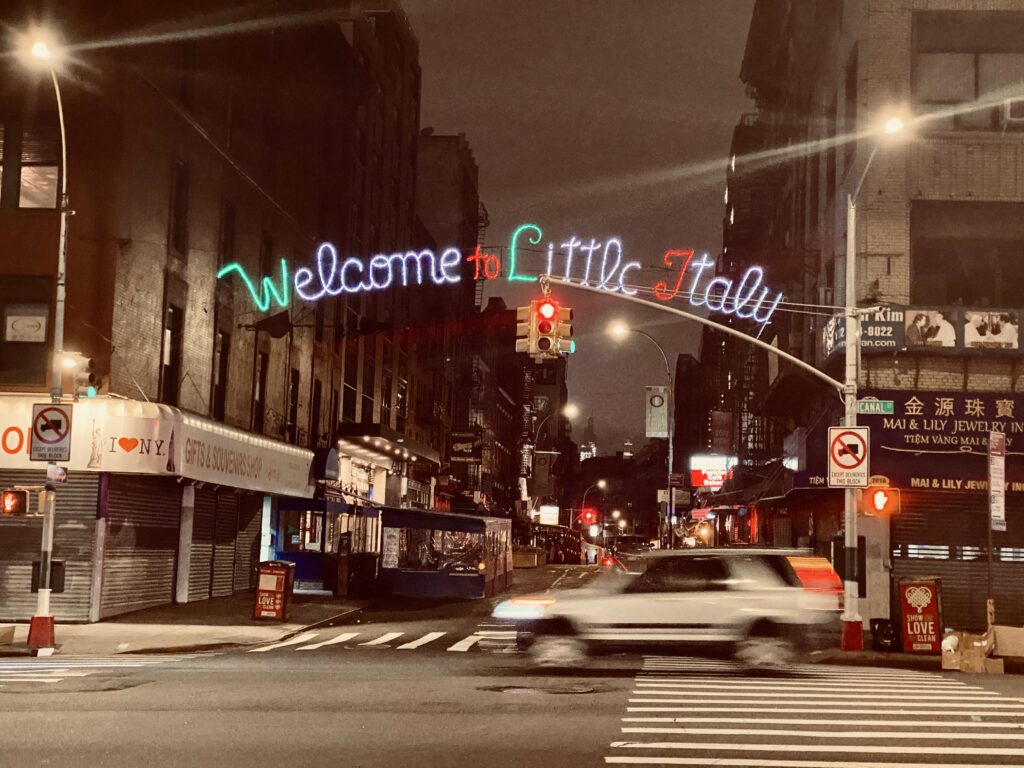
You can’t miss the famous “Welcome to Little Italy” banner that hangs over Mulberry Street.
It marks the shift from dumpling shops and fish markets to cannoli stands and red-sauce pasta joints.
It’s a festive, albeit very touristy, landmark that signals you have arrived in a neighborhood that feels like a movie set.
Walk down Mulberry Street towards the Empire State Building.
It is lined with restaurants, cafes, and souvenir shops.
In the warmer months, the street is often closed to cars, and restaurants set up tables outside, creating a lively European atmosphere.
Insider Tip: Look down! The transition is often abrupt. You might be smelling soy sauce one second and garlic bread the next.
Why Visit: It’s the classic photo op that proves you visited these two distinct cultural neighborhoods.
J. Tristan Eaton’s “Audrey Hepburn” Mural
We end our walk at one of the most famous murals in Little Italy.
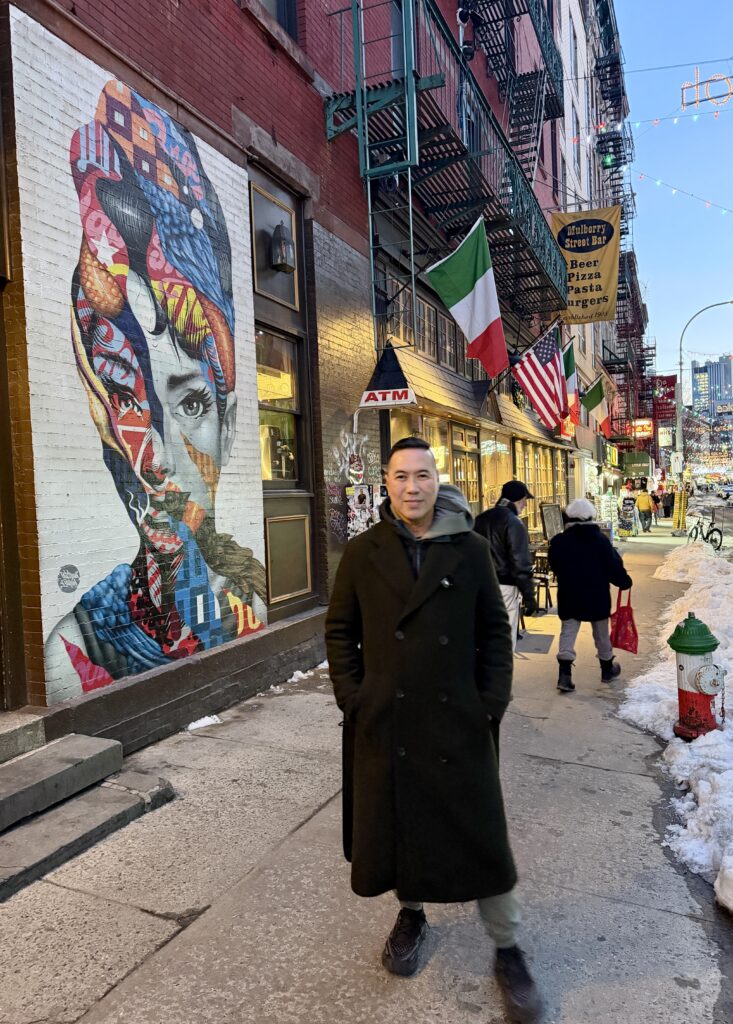
Tristan Eaton’s iconic “Audrey Hepburn” mural is a vibrant fusion of classic Hollywood glamour and modern street art, featuring a pop-art style portrait of the actress adorned with intricate, colorful patterns.
Ending your walk here is perfect because the mural stands as a symbol of the neighborhood’s artistic evolution, blending the traditional “Old World” feel of Little Italy with contemporary creative energy.
Its location on Mulberry Street puts you in the heart of the district, making it an ideal final landmark for photos before you transition into a well-deserved meal at one of the nearby legendary eateries
I listed a few iconic eateries in Little Italy and Chinatown in the next section.
Kris and the Audrey Hepburn Mural
Worth The Detour: Big City of Dreams Mural
Where: Broome Street (between Mulberry and Lafayette)
The Secret: If you enjoyed seeing the iconic Audrey Hepburn mural at the corner of Mulberry and Broome, you have to take this quick one-block detour to see its sibling: “Big City of Dreams.” Also created by world-renowned street artist Tristan Eaton for the L.I.S.A. Project, this massive, colorful collage is a tribute to the hustle and heart of New York. While the Audrey mural captures the elegance of the neighborhood, Big City of Dreams captures its chaotic, patchwork energy.
Frugal/Health Win: Both of these murals are part of Manhattan’s only “mural district,” making this area a free, open-air museum. As I continue my heart-healthy walking journey, I’ve realized that murals like these are perfect “pacing milestones.” Standing before this wall, you can see snippets of NYC history all woven together. It’s a great reminder that our own lives are often a “patchwork” of different experiences, both tough and beautiful, that eventually come together to create something vibrant and strong.
Chinatown Recommended Eateries
Nom Wah Tea Parlor: Nom Wah Tea Parlor is NYC’s oldest dim sum parlor (opened in 1920), famous for its vintage atmosphere and “Original OG” egg rolls.
Mei Lai Wah: Mei Lai Wah is a legendary bakery best known for its unrivaled baked pineapple BBQ pork buns that often have a line out the door.
Shu Jiao Fu Zhou: Shu Jiao Fu Zhou is a frugal favorite serving authentic Fuzhou-style thin-skinned dumplings and chewy peanut butter noodles for under $5.
Spicy Village: Spicy Village is a cult-favorite for Henan cuisine, specifically their “Spicy Big Tray Chicken” served with hand-pulled wide noodles.
Wah Fung No. 1: Wah Fung No. 1 Fast Food is a tiny counter famous for high-quality roasted meats (Cha Siu) over rice at some of the best prices in the city.
Golden Unicorn: Golden Unicorn is a classic, upscale multi-floor dim sum palace where you can experience traditional cart service in a festive, banquet-style setting.
Wo Hop (Downstairs): Wo Hop is an iconic 17 Mott Street institution since 1938, serving old-school Cantonese-American comfort food.
Hop Kee: an Anthony Bourdain favorite that serves popular Cantonese dishes.
Joe’s Steam Rice Roll: Located in Canal Street Market, Joe’s Steam Rice Roll offers stone-milled Cantonese rice crepes made fresh to order.
Chinatown Ice Cream Factory: Chinatown Ice Cream Factory is a family-run landmark since 1978, featuring unique flavors like black sesame, durian, and ginger.
Little Italy Recommended Eateries
Da Gennaro: Located on the site of the former Umberto’s Clam House (infamous for the 1972 Joey Gallo shooting), it is known for hearty Italian seafood and homemade sauces.
Mulberry Street Bar: Operating since 1908, this bar retains a vintage interior and has appeared in classic films like The Godfather Part III and Donnie Brasco. It is also located right before our last stop – the Audrey Hepburn mural.
Lombardi’s Pizzeria: Lombardi’s is widely recognized as the first pizzeria in the United States (established 1905), famous for its smoky, coal-fired thin-crust pizzas.
Ferrara Bakery & Café: Ferrara Bakery is one of America’s oldest Italian bakeries (est. 1892), an essential stop for espresso, cannoli, and lobster tails (sfogliatelle).
Di Palo’s Fine Foods: Di Palo’s is a family-run artisanal shop since 1925, offering a museum-like experience of imported Italian cheeses, meats, and olive oils.
Caffé Palermo: Caffé Palermo is home to the self-proclaimed “Cannoli King,” serving some of the most famous ricotta-filled pastries in the neighborhood since 1973.
Final Thoughts
Exploring Chinatown and Little Italy is always a sensory whirlwind, but doing it while recovering from heart bypass surgery has given me a whole new appreciation for these streets.
From the historic layers of the African Burial Ground to the modern, soaring colors of Tristan Eaton’s murals, these neighborhoods are built on resilience and reinvention – much like the journey of recovery itself.
Whether you are here to hunt for the best $5 peanut butter noodles, use your Hyatt points for a luxury stay at the Hotel 50 Bowery, or simply to get your 4,500 steps in, I hope this walk reminded you that the best parts of New York don’t require a massive budget.
They just require a comfortable pair of shoes and a bit of curiosity.
Until the next walk, keep exploring, stay frugal, and keep moving!
ADVERTISER DISCLOSURE: The Frugal Tourist is part of an affiliate sales network and receives compensation for sending traffic to partner sites, such as MileValue.com. This compensation may impact how and where links appear on this site. This site does not include all financial companies or all available financial offers. Terms apply to American Express benefits and offers. Enrollment may be required for select American Express benefits and offers. Visit americanexpress.com to learn more. All information about the American Express Schwab Platinum has been collected independently by The Frugal Tourist.
EDITORIAL DISCLOSURE: Opinions, reviews, analyses & recommendations are the author’s alone and have not been reviewed, endorsed, or approved by any of these entities.
USER-GENERATED CONTENT DISCLOSURE: The comments section below is not provided or commissioned by the bank advertiser. Responses have not been reviewed, approved, or otherwise endorsed by the bank advertiser. It is not the bank advertiser’s responsibility to ensure all questions are answered.